Chad Jones’ Theater Dogs

June 20, 2008

Review: `The Busy World Is Hushed’

Opened June 19, 2008 at the Aurora Theatre Company, Berkeley


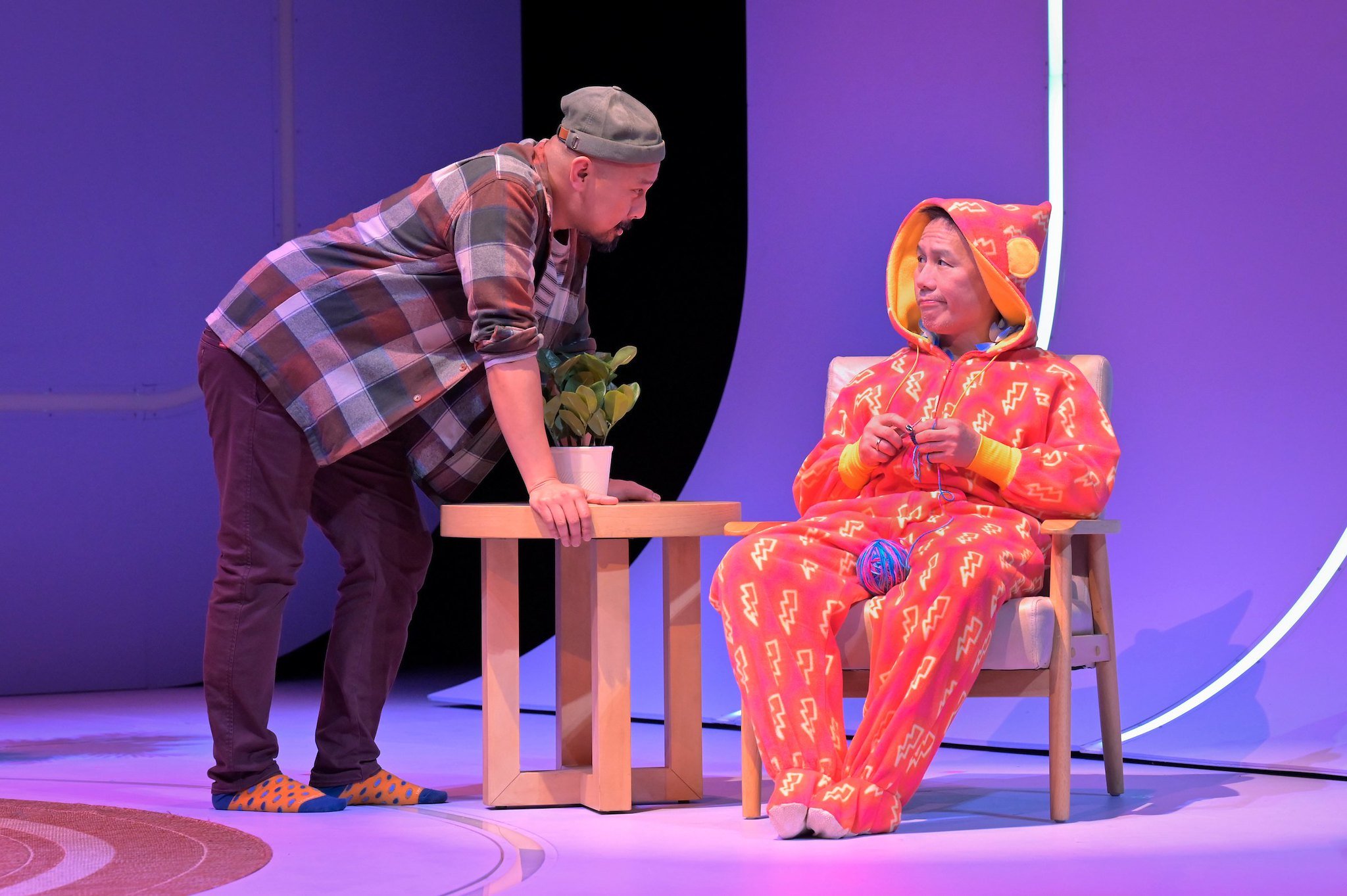
Anne Darragh (left) is an Episcopalian minister and Chad Deverman is her writing assistant in Keith Bunin’s The Busy World Is Hushed at the Aurora Theatre Company in Berkeley. Photos by David Allen


Thoughts on faith, love, family make noise in Hushed
««« ½

Aurora Theatre Company concludes its 16th season with a thoughtful love story/dysfunctional family drama cloaked in theological robes.

Keith Bunin’s The Busy World Is Hushed has its soapy, melodramatic moments, but there’s much more to the play – musings on gays, God, getting lost and being found — that satisfies both intellectually and emotionally.

There aren’t that many plays around that address the notion of faith from both an organized religion standpoint and from a less structured spiritual place. Bunin’s play opens the conversation without preaching too hard or making anyone look foolish. That in itself makes the play worth seeing.

In addition to an intelligent discussion of God’s place in our modern lives, Busy World throws in a tortured mother-son relationship, a love story between two mid-20s men and a crisis of faith for a son slowly losing his father to a terminal illness. That’s a lot to stuff into two hours, but Bunin manages it, and director Robin Stanton (who did such wonderful work on the Aurora’s Permanent Collection) lends it a naturalism infused with realistic rhythms that pull the audience into the fraught conversations.

How appropriate that this tale is told simply – one set (by Eric E. Sinkkonen, complete with stained-glass windows above, and a regular window looking out onto a cold, gray New York) and a trinity of characters in various stages of belief.

Hannah (Anne Darragh) is an Episcopalian minister and seminary professor. She is a great believer in God – not the God depicted in stained-glass windows or trumped up Catholic mythology but the human Jesus who spoke and taught and performed miracles. She’s liberal in her beliefs but strict in her faith. She’s in the process of decoding a newly discovered gospel that could turn out to predate the existing gospels in the Bible, and if genuine, could be the closest thing to the true words of Christ.

To help her write the book on the gospels, she has hired an aspiring author, Brandt (Chad Deverman), whose own writing is blocked and needs a project to help him concentrate. Brandt’s father has been diagnosed with a brain tumor, and his belief in anything is severely shaken. “All religion,” Brandt says, “is an attempt to make death more bearable.”

And then there’s Hannah’s 26-year-old son, Thomas (James Wagner), who doesn’t believe in anything beyond running away. He has just returned from “getting lost,” a game he plays where he throws himself into someplace wild with few provisions then challenges himself to make it out alive. Damaged by his father’s death (and possible suicide) before he was even born, Thomas resents his mother’s immersion in faith and the fact that her relationship with Jesus is often stronger than her relationship with him.

Stanton’s actors are excellent, and this is one of those plays that benefits tremendously from the Aurora’s intimacy. There’s no escaping the passion of Thomas and Brandt’s budding romance just as there’s no turning away from the final confrontation between mother and son, with God, hypocrisy and loneliness wafting through the chasm between them. Bunin comes down hard on Hannah and Thomas, and their rift, full of harsh accusations and hard truths, is truly painful.

There’s not a lot of peace or resolution in this Busy World, which is best, but there’s a lot of common sense and even insight into the complexities of faith and the complexities of living outside faith. Hearts and souls are tangled and torn, God is abused and praised. And the audience is left in a state of contemplation.

The Busy World Is Hushed continues through July 20 at the Aurora Theatre Company, 2081 Addison St., Berkeley. Tickets are $40-$42. Call 510-843-4822 or visit www.auroratheatre.org for information.

The play’s title, by the way comes from the following benediction:

May the Lord support us all the day long,
Till the shades lengthen and the evening comes
and the busy world is hushed,
and the fever of life is over,
and our work is done.

Then in his mercy may he give us
a safe lodging
and a holy rest,
and peace at last.

June 16, 2008

Missing the Tonys

For the last four days I’ve been in Ashland, Ore., reviewing shows at the Oregon Shakespeare Festival for the San Francisco Chronicle (more on that later), and while the Tonys were on Sunday night, I was at the opening of a new musical adaptation of Shakespeare’s The Comedy of Errors. Of course I’ll watch the whole awards show on TiVo when I get home, but I was able to catch glimpses here and there (thanks to the spotty www.tonyawards.com online coverage), and of course I couldn’t wait to find out the winners.

I must say I’m disappointed that Passing Strange only one award (for best book of a musical). I guess I’m feeling territorial because the show had its world premiere at Berkeley Repertory Theatre. Still, it’s better than nothing. Here’s what co-creator and star Stew had to say about his win:

“Music is something that comes easy to me, and I’ve received numerous accolades for my songs - but to be honored for my writing means a whole hell of a lot, especially when it comes from theatre people for whom words really mean something. Those words took shape at Berkeley Rep, a place that makes space for people like me to take risks and try out things that theatre isn’t used to seeing. We loved working there, and we miss that Berkeley scene.”

More on the Tonys later. In the meantime, here’s a complete list of winners:

Play (and playwrights): “August: Osage County” (Tracy Letts).

Musical: “In the Heights.”

Book-Musical: “Passing Strange” (Stew).

Original Score (music and/or lyrics): “In the Heights” (Music & Lyrics: Lin-Manuel Miranda).

Revival-Play: “Boeing-Boeing.”

Revival-Musical: “South Pacific.”

Actor-Play: Mark Rylance, “Boeing-Boeing.”

Actress-Play: Deanna Dunagan, “August: Osage County.”

Actor-Musical: Paulo Szot, “South Pacific.”

Actress-Musical: Patti LuPone, “Gypsy.”

Featured Actor-Play: Jim Norton, “The Seafarer.”

Featured Actress-Play: Rondi Reed, “August: Osage County.”

Featured Actor-Musical: Boyd Gaines, “Gypsy.”

Featured Actress-Musical: Laura Benanti, “Gypsy.”

Direction-Play: Anna D. Shapiro, “August: Osage County.”

Direction-Musical: Bartlett Sher, “South Pacific.”

Choreography: Andy Blankenbuehler, “In the Heights.”

Orchestrations: Alex Lacamoire and Bill Sherman, “In the Heights.”

Scenic Design-Play: Todd Rosenthal, “August: Osage County.”

Scenic Design-Musical: Michael Yeargen, “South Pacific.”

Costume Design-Play: Katrina Lindsay, “Les Liaisons Dangereuses.”

Costume Design-Musical: Catherine Zuber, “South Pacific.”

Lighting Design-Play: Kevin Adams, “The 39 Steps.”

Lighting Design-Musical: Donald Holder, “South Pacific.”

Sound Design-Play: Mic Pool, “The 39 Steps.”

Sound Design-Musical: Scott Lehrer, “South Pacific.”

Previously announced:

Regional Theater Tony Award: Chicago Shakespeare Theater.

Special Tony Award: Robert Russell Bennett.

Lifetime Achievement Award: Stephen Sondheim.

June 11, 2008

Ramping up to the Tony Awards

This Sunday, the Tony Awards will be handed out.
Here’s what you need to know (and get busy organizing your Tony party — we’ve got to get those dismal ratings out of the basement so CBS will continue broadcasting the darn things).

For the first time, there will be pre-ceremony Tony Concert chock full of juicy musical numbers from all the nominated shows. In the Bay Area the concert will be at 1 p.m. Sunday, June 15 on KPIX-TV. Mario Lopez (currently playing Zach in A Chorus Line) hosts, and we’ll see numbers from 10 musicals: A Catered Affair, Cry-Baby, Grease, Gypsy, In The Heights, Passing Strange, South Pacific, Sunday in the Park with George, The Little Mermaid and Xanadu—on stage at the Allen Room at Frederick P. Rose Hall, home of Jazz at Lincoln Center, with its spectacular, floor-to-ceiling views of Central Park South visible to viewers of the telecast.

Nominees who perform on the program include Laura Benanti (Gypsy), Daniel Breaker and Stew (Passing Strange), Kerry Butler (Xanadu), Daniel Evans (Sunday in the Park with George), Faith Prince (A Catered Affair) and Loretta Ables Sayre (South Pacific).

“We’ve tried very hard not to cannibalize anything that will be on the actual Tony telecast, but just to whet people’s appetites for June 15,” says The Broadway League’s Jan Friedlander Svendsen, who is an executive producer of the special. “We purposely didn’t want this in costume, we didn’t want big production numbers. We wanted it to feel very intimate. And we wanted to have those up-close-and-personal profiles.”

Actor nominees who are interviewed during the pre-Tony telecast include Laurence Fishburne, who talks about his role as a Supreme Court justice in Thurgood, and Patrick Stewart and Kate Fleetwood, who reveal a touching story from the casting of their revival of Macbeth. Steppenwolf Theatre Company members Laurie Metcalf (November) and Deanna Dunagan, Amy Morton and Rondi Reed from the Best Play nominee August: Osage County celebrate the success of Steppenwolf-ers on Broadway this season—the roster also includes Martha Plimpton and Kevin Anderson—who all told represent six different Broadway shows.

“One of the issues with the Tonys is, often times, not all of our nominees are as well known as, say, Oscar nominees,” says Svendsen. “It’s great to let audiences be exposed to some of those who aren’t as well known. It’s kind of like the Olympics. Many of those athletes aren’t as famous, and one of my favorite parts of watching the Games is getting to know those athletes from a human interest side. Then I have an emotional connection with them and a more rooting interest in who’s going to win.”

The Awards, hosted by Whoopi Goldberg (thank God someone on “The View” cares about theater since Rosie O’Donnell’s departure) begin at 8 p.m. on TV, but watching the tape delay is so retro. Why not tune into the live Webcast? Past Tony winners Michael Cerveris and Julie White host. Log on to www.tonyawards.com for all the details.

On the broadcast, we’ll get musical numbers from all four of the Best Musical nominees (Cry-Baby, In The Heights, Passing Strange and Xanadu) and the four Best Musical Revival nominees (Grease, Gypsy, Sunday in the Park with George and Rodgers & Hammerstein’s South Pacific).

Also represented will be three other new Broadway musicals: A Catered Affair, The Little Mermaid and The New Mel Brooks Musical Young Frankenstein. And just for good measure, Rent and The Lion King will also make appearances.

Video memories from past Tony winners, clips from nominated shows and a whole lot more await you at www.tonyawards.com, your one-stop shop for Tony Award information.

To whet your appetite, here’s Passing Strange on “The View.”

May 29, 2008

Review: `Octopus’

Extended through June 21 at the Magic Theatre, San Francisco

Kevin (Eric Kerr, left) and Max (Liam Vincent) wade through murky relationship waters in Steve Yockey’s provocative Octopus, a co-production of the Magic Theatre and Encore Theatre Company. Photos by www.DavidAllenStudio.com.


Yockey’s Octopus explores inky waters of commitment
«««1/2 Dripping with intrigue

Steve Yockey’s Octopus is a thrilling, somewhat frustrating theatrical experience.

This inaugural co-production of the Magic Theatre and Encore Theatre Company delivers a first-rate production of a fascinating world-premiere play that ultimately comes up a little short only because Yockey sets the bar so high for himself at the outset.

What starts as another riff on gay romantic situation comedies quickly turns into something quite different then evolves into something else shortly after that.

Committed couple Blake (Patrick Alparone) and Kevin (Eric Kerr) are hoping to liven things up by inviting another couple to join them in the bedroom. “It’s something guys do,” Kevin says. Into their neat little urban apartment (fantastic set by Erik Flatmo, more on that in a minute) steps longtime couple Max (Liam Vincent) and Andy (Brad Erickson). While Andy natters on about wine, the voracious Max practically devours Blake with just a glance.

Director Kate Warner masterfully amps up the tension between the four men – as couples and as individuals – to humorous and then to anxiety-inducing levels. Soon enough, though, the clothes come off as Jarrod Fischer’s lights politely dim and the huddle of flesh makes its way to the bed. But things don’t turn out exactly as planned. Feelings are hurt, boundaries are crossed and the flood is unleashed. HIV-AIDS looms, even though Blake says: “It’s not even something people get anymore.”

Yockey is a funny, assured writer, and director Warner and her actors find the rhythms that heighten the laughs (”Don’t say my name like it tastes bad,” Blake snaps, or here’s Max describing a convoluted coffee order: “It’s like an insane caffeinated yard sale in a cup.”) and then underscore the drama. The tone of the play changes with the arrival of a telegram delivery guy (Rowan Brooks), who happens to be sopping wet. Danger fairly drips from the cheerful man, and with each telegram, Octopus grows more chilling.

The ability of Flatmo’s set to hold water becomes increasingly important as action shifts to the bottom of the sea and to apartments overrun with the fluid embodiment of fear – fear of death, fear of commitment, fear of anything honest and real. There’s brilliance in the set-up, with the ocean becoming a metaphor for illness and isolation and sea monsters becoming the threat of imminent death.

The fact that Warner and her crew pull off the aquatic special effects as well as they do carries the last portion of the 70-minute play, even as Yockey sets up a dramatic confrontation between the fearful Kevin and the increasingly angry telegram guy. By this point in the play, we’re literally swimming in metaphor (especially the people in the front row), and the function of the grim-reaperish telegram guy diminishes. We get it, so his presence, especially as the catalyst for dénouement never feels quite right (through no fault of Brooks, who is pitch perfect).

There’s still plenty of power and emotion in Yockey’s ending thanks largely to the excellent Alparone and Kerr, but getting there somehow took an unnecessary detour. And this is much too fascinating a play for detours. One of the hardest things to do in a theater is to scare people, but Octopus, with its crazy sea monsters (and rattling sound design by Sara Huddleston) and astounding imagery, comes close multiple times.

There’s something chilling about Octopus, and it’s not just because the theater is filled with water.

Octopus continues through June 21 at the Magic Theatre, Building D, Fort Mason Center, Marina Boulevard at Buchanan Street, San Francisco. Tickets are$40-$45. Call 415-441-8822 or visit www.magictheatre.org for information.

May 18, 2008

Broadway `Cat’ headed for big screen?

Filed under: Anika Noni Rose, Broadway, Tennessee Williams, Terrence Howard, movies, plays — Chad Jones @ 9:36 am


Anika Noni Rose and Terrence Howard in the Broadway production of Cat on a Hot Tin Roof. Photo by the New York Times

Interesting article in Variety about the recent Broadway production of Tennessee Williams’ Cat on a Hot Tin Roof starring James Earl Jones, Phylicia Rashad, Terrence Howard and Anika Noni Rose.

Not surprisingly, this camera-ready cast may be taking the play to the big screen. Of course, Cat has already prowled the cinema once before: with Paul Newman, Burl Ives and Elizabeth Taylor in 1958.

The Broadway production, which concludes on June 22, recouped its $2.1 million investment and is happily headed into profit.

Producer Stephen Byrd, who is making noise about the Cat movie, is also considering a simulcast of a live performance of of the play to be shown in Regal Cinemas across the country.

Read the Variety article here.

May 16, 2008

The (puppet) theory of (puppet) relativity

Here’s an intriguing subtitle: “A found-object puppetry play inside the mind of Albert Einstein.”

That subtitle is attached to One Stone: Einstein, a work-in-progress from two of the Bay Area’s leading theatrical lights: playwright Trevor Allen and puppeteer Liebe Wetzel (along with her Lunatique Fantastique puppeteers).

The play, which involves found text, found-object puppets and David Sinaiko as Albert Einstein, receives two readings: 7:30 p.m. Monday, May 19 at Stanford University and 7 p.m. Tuesday, May 20 at Traveling Jewish Theatre (470 Florida St., San Francisco). These are free “in the rough” presentations presented by the Playwrights Foundation.

You can RSVP by e-mailing rsvp@playwrightsfoundation.org or by calling 415-626-0453, ext. 105.

May 15, 2008

Review: ‘Bug’

Filed under: Gabe Marin, SF Playhouse, Susi Damilano, Tracy Letts, local theater, plays, theater review — Chad Jones @ 10:56 pm

At The SF Playhouse through June 14


Susi Damilano is Agnes and Gabriel Marin is Peter in Tracy Letts’ Bug at the SF Playhouse. Photos by Zabrina Tipton.


It sure is fun to watch an audience squirm. It’s even more fun to be part of that squirming audience.

Tracy Letts’ Bug, now at the SF Playhouse’s intimate, creepy-crawly theater space, has some juicy moments that make the audience cringe collectively. What else do you do when a probably crazy man attempts to extract one of his own molars with a pair of pliers? You squirm. You cringe. You have a good time – if horror-type thrills are your idea of a good time.

When it comes right down to it, Letts’ Bug, which has been a hit in London and off-Broadway, is a mix of paranoid sci-fi thriller from the 1950s and 1970s white-trash B movie. The fact that Letts is a skillful enough writer to make it all seem much more important means the work seems somehow more important than it actually is, and that’s a good trick. Bug is more fun than Letts’ trashy Killer Joe, which the Bay Area saw when Marin Theatre Company transferred its successful production to San Francisco. And it’s probably not as good as August: Osage County, the Broadway drama that just won Letts a Pulitzer Prize.

In Bug, Letts is dealing with lonely people and a whopper of a conspiracy theory, which makes them both feel a whole lot less lonely. Agnes (Susi Damilano) lives in a skeezy Oklahoma hotel room. She’s terrified her ex-husband, Jerry (John Flanagan) will get out of jail and come back to terrorize her some more. One night, while killing the pain with her friend R.C. (Zehra Berkman) and several lines of coke and a few puffs off the ol’ pipe, Agnes meets Peter (Gabriel Marin), a shy, intelligent drifter who needs a place to stay for the night.

You don’t have to ask Agnes twice. Just make her a cocktail – vodka and Coke – and you’re in. It won’t take long to learn Agnes’ biggest sorrow: her 6-year-old son disappeared from the grocery store about 10 years ago. Life just hasn’t been the same since. While Steve Wonder’s “Superstitious” plays on the radio, Agnes and Peter waltz through their strange courtship ritual. Agnes bares her soul and Peter theorizes about how none of us is ever really safe because of the chemicals, the technology and the information out there being generated by people and their machines.

Ah, the wondrous smell of romance and paranoia. Such a heady combination.

The titular bug first appears in the form of a chirping cricket, which actually turns out to be a faulty smoke alarm, which turns out to be more radioactive than plutonium (funny how you don’t read about that on the smoke alarm box). Then, one amorous evening, Peter awakes to find bug bites on his arm. He discovers aphids – he calls them plant lice – in the bed and the bug adventure really begins.

Peter sucks Agnes into his buggy world, a horrific place where soldiers are experimented on by demented doctors in the hope of creating bio chips to mark every human being since 1982. Or something like that. Peter, it turns out, is on the run and can’t let the bad people find him. They’re the ones that infested him with bugs. And Agnes believes every word.

Marin brings incredible intensity to his performance. When it looks like Agnes might leave him, Peter throws an incredible fit – it’s a wonder Marin doesn’t destroy Bill English’s superb hotel room set with his thrashing about. There’s also quietness in Peter – a sort of dim light of intelligence that belies all the weird stuff and makes you wish we were meeting him under less exterminating circumstances.

Damilano’s naturalness makes Agnes likable and understandable. We feel for her and watch helplessly as she gets sucked into the paranoia. There’s an incredible scene in Act 2, really the heart of the play, when Letts gives Agnes a monologue that makes a case for human faith, intelligence and gullibility as interchangeable pieces of our brain structure. Damilano sinks her teeth into the moment and makes it as powerful as it is sad.

Director Jon Tracy goes less for horror than for humor in this production. In Act 2, the tension goes slack when it should be taut, but Damilano and Marin (who appears bloody and shirtless through much of the play) somehow keep the play on track, making this a dramatic infestation you don’t mind squirming your way through.

Bug continues through June 14 at the SF Playhouse, 533 Sutter St., San Francisco. Tickets are $38. Call 415-677-9596 or visit www.sfplayhouse.org for information.

May 13, 2008

Tony, Tony, Tony!

Tony Award nominations are out today. Here’s how it shook out:

BEST PLAY:
August: Osage County by Tracy Letts
Rock ‘n’ Roll by Tom Stoppard
The Seafarer by Conor McPherson
The 39 Steps by Patrick Barlow

BEST MUSICAL:
Cry-Baby
In The Heights
Passing Strange
Xanadu

BEST BOOK OF A MUSICAL:
Cry-Baby by Mark O’Donnell and Thomas Meehan
In the Heights by Quiara Alegría Hudes
Passing Strange by Stew
Xanadu Douglas by Carter Beane

BEST ORIGINAL SCORE (MUSIC/LYRICS) WRITTEN FOR THE THEATER:
Cry-Baby Music & Lyrics: David Javerbaum & Adam Schlesinger
In the Heights Music & Lyrics: Lin-Manuel Miranda
The Little Mermaid Music: Alan Menken; Lyrics: Howard Ashman and Glenn Slater
Passing Strange Music: Stew and Heidi Rodewald; Lyrics: Stew

BEST REVIVAL OF A PLAY:
Boeing-Boeing
The Homecoming
Les Liaisons Dangereuses
Macbeth

BEST REVIVAL OF A MUSICAL:
Grease
Gypsy
Rodgers & Hammerstein’s South Pacific
Sunday in the Park with George

BEST PERFORMANCE BY A LEADING ACTOR IN A PLAY:
Ben Daniels, Les Liaisons Dangereuses
Laurence Fishburne, Thurgood
Mark Rylance (right), Boeing-Boeing
Rufus Sewell, Rock ‘n’ Roll
Patrick Stewart, Macbeth

BEST PERFORMANCE BY A LEADING ACTRESS IN A PLAY:
Eve Best, The Homecoming
Deanna Dunagan, August: Osage County
Kate Fleetwood, Macbeth
S. Epatha Merkerson, Come Back, Little Sheba
Amy Morton, August: Osage County

BEST PERFORMANCE BY A LEADING ACTOR IN A MUSICAL:
Daniel Evans, Sunday in the Park with George
Lin-Manuel Miranda, In the Heights
Stew, Passing Strange
Paulo Szot, Rodgers & Hammerstein’s South Pacific
Tom Wopat, A Catered Affair

BEST PERFORMANCE BY A LEADING ACTRESS IN A MUSICAL:
Kerry Butler, Xanadu
Patti LuPone (right), Gypsy
Kelli O’Hara, Rodgers & Hammerstein’s South Pacific
Faith Prince, A Catered Affair
Jenna Russell, Sunday in the Park with George

BEST PERFORMANCE BY A FEATURED ACTOR IN A PLAY:
Bobby Cannavale, Mauritius
Raúl Esparza, The Homecoming
Conleth Hill, The Seafarer
Jim Norton, The Seafarer
David Pittu, Is He Dead?

BEST PERFORMANCE BY A FEATURED ACTRESS IN A PLAY:
Sinead Cusack, Rock ‘n’ Roll
Mary McCormack, Boeing-Boeing
Laurie Metcalf, November
Martha Plimpton, Top Girls
Rondi Reed, August: Osage County

BEST PERFORMANCE BY A FEATURED ACTOR IN A MUSICAL:
Daniel Breaker, Passing Strange
Danny Burstein (above), Rodgers & Hammerstein’s South Pacific
Robin De Jesús, In The Heights
Christopher Fitzgerald, The New Mel Brooks Musical Young Frankenstein
Boyd Gaines, Gypsy

BEST PERFORMANCE BY A FEATURED ACTRESS IN A MUSICAL:
de’Adre Aziza, Passing Strange
Laura Benanti, Gypsy
Andrea Martin, The New Mel Brooks Musical Young Frankenstein
Olga Merediz, In The Heights
Loretta Ables Sayre, Rodgers & Hammerstein’s South Pacific

BEST DIRECTION OF A PLAY:
Maria Aitken, The 39 Steps
Conor McPherson, The Seafarer
Anna D. Shapiro, August: Osage County
Matthew Warchus, Boeing-Boeing

BEST DIRECTION OF A MUSICAL:
Sam Buntrock, Sunday in the Park with George
Thomas Kail, In the Heights
Arthur Laurents Gypsy
Bartlett Sher Rodgers & Hammerstein’s South Pacific

BEST CHOREOGRAPHY:
Rob Ashford, Cry-Baby
Andy Blankenbuehler, In the Heights
Christopher Gattelli, Rodgers & Hammerstein’s South Pacific
Dan Knechtges, Xanadu

BEST ORCHESTRATIONS:
Jason Carr, Sunday in the Park with George
Alex Lacamoire & Bill Sherman, In The Heights
Stew & Heidi Rodewald, Passing Strange
Jonathan Tunick, A Catered Affair

BEST SCENIC DESIGN OF A PLAY:
Peter McKintosh, The 39 Steps
Scott Pask, Les Liaisons Dangereuses
Todd Rosenthal, August: Osage County
Anthony Ward, Macbeth

BEST SCENIC DESIGN OF A MUSICAL:
David Farley and Timothy Bird & The Knifedge Creative Network, Sunday in the Park with George
Anna Louizos, In the Heights
Robin Wagner ,The New Mel Brooks Musical Young Frankenstein
Michael Yeargan, Rodgers & Hammerstein’s South Pacific

BEST COSTUME DESIGN OF A PLAY:
Gregory Gale, Cyrano de Bergerac
Rob Howell, Boeing-Boeing
Katrina Lindsay, Les Liaisons Dangereuses
Peter McKintosh, The 39 Steps

BEST COSTUME DESIGN OF A MUSICAL:
David Farley, Sunday in the Park with George
Martin Pakledinaz, Gypsy
Paul Tazewell, In the Heights
Catherine Zuber, Rodgers & Hammerstein’s South Pacific

SPECIAL TONY AWARD FOR LIFETIME ACHIEVEMENT IN THE THEATER:
Stephen Sondheim

REGIONAL THEATER TONY AWARD:
Chicago Shakespeare Theatre

SPECIAL TONY AWARD:
Robert Russell Bennett (1894-1981), in recognition of his historic contribution to American musical theatre in the field of orchestrations, as represented on Broadway this season by Rodgers & Hammerstein’s South Pacific.

For a complete list of nominees visit the American Theatre Wing’s Web site.

Review: `No Child…’

Filed under: Berkeley Repertory Theatre, Nilaja Sun, local theater, plays, theater review — Chad Jones @ 9:43 am

Opened May 12, 2008 on Berkeley Repertory Theatre’s Thrust Stage
EXTENDED AGAIN THROUGH JUNE 11!!!


Nilaja Sun in her dynamic, moving solo show No Child… at Berkeley Repertory Theatre.
Photos by Carol Rosegg

Sun shines in extraordinary solo show
four stars An apple for the teacher

Nilaja Sun has been performing her solo show No Child… off and on for two years now, but you wouldn’t know that from the incredibly fresh energy she brings to it.

The show, an autobiographical tale of a teaching artist bringing theater to a rough Bronx public school, premiered at New York’s Epic Theatre Center almost exactly two years ago. Then came a rush of awards – an Obie, a Lucille Lortel, an Outer Critics Circle Award, a U.S. Comedy Arts Festival Award, a Theater World Award – all of which were well deserved.

The thing about Sun’s show – aside from the incredible talent she displays that conjures up the excitement of watching a young Whoopi Goldberg or Lily Tomlin or Sarah Jones – is that it ends up being the best possible kind of activist theater.

Using humor, theatricality and some of the most precise and thrilling physical stage work I’ve ever seen, Sun becomes the entire adult and student population at Malcolm X High School. Well, OK, not the entire school but a portion of the administration and one unruly 10th grade English class. I lost track of how many roles she plays exactly, but it’s well more than a dozen, and each one is distinct.

Working with director Hal Brooks, Sun speeds through her tale in nearly 70 minutes. The brevity of the story shortchanges the drama somewhat – we’d be happy to spend more time with Sun and her “cast” – and lends an “Afterschool Special” vibe to what should be more realistic.

But Sun’s message comes through quite distinctly: we are shortchanging public school students and, to paraphrase Sun, we are preparing them more to be inmates than to be leaders.

Our narrator is an African-American janitor who has been at the school for nearly 50 years. Reminiscent of the Stage Manager in Our Town, the janitor sets the stage for us (the tiled hallways of the school nicely evoked in the set by Narelle Sissons and Sibyl Wickersheimer): this is the classroom of a beleaguered new teacher named Ms. Tam (a former Wall Street high roller who wanted to do something more with her life), who is unable to control her wild students.

Into this unruly den comes Ms. Sun, a “teaching artist” who will spend the next six weeks with the students working on a play – analyzing, rehearsing and performing. And no, Ms. Sun says, they will be doing neither A Raisin in the Sun nor West Side Story. They will be performing Timberlake Wertenbaker’s Our Country’s Good, which is about 18th-century Australian convicts performing a play within the play.

It’s a brilliant choice of play because there’s so much in it that celebrates the power of theater at its most elemental (and Berkeley Rep staged the play on this same stage in 1990 – my first-ever Berkeley Rep show). In addition to making cogent points about the failure of the current administrations No Child Left Behind test-focused approach to public education, she also gets to demonstrate how important the arts – especially theater – are to the development of young people.

The students Ms. Sun is working with – the sassy Shadrika, the tough kingpin Jerome, the hyper Hispanic Jose, the nerdy Chris, the tongue-tied Chris and so on – all come to life as they rehearse the play and prepare for their one-night-only performance. Real life (and mortality) interferes, but the show must go on. “These kids need a miracle,” a nearly depleted Ms. Sun says. “They need a miracle, like, every day.”

Ms. Sun nearly quits, and in so doing, unleashes the play’s most vociferous plea to respect, properly train and adequately compensate teachers, who have the world’s toughest job. No argument there.

More than just entertaining, No Child… is inspiring. You exit the theater vibrating at Sun’s frequency, which is amazingly high, and you want to channel that energy into making life better for students who, used to being given up on, are given a chance to become fully themselves.

No Child… continues through June 11 on the Thrust Stage, 2025 Addison St., Berkeley. Tickets are $27-$69. Call 510-647-2949 or visit www.berkeleyrep.org for information.

May 1, 2008

Review: `Curse of the Starving Class’

Opened April 30 at American Conservatory Theater


Pamela Reed (left) as Ella, chucks artichokes out of the fridge across a prone Jack Willis as Weston and toward Jud Williford as her son, Wesley in ACT’s Curse of the Starving Class by Sam Shepard. Photos by Kevin Berne


Shepard’s revised `Curse’ still packs punch
Three stars Let it bleat

Lambs, it turns out, are stage hogs.

There’s an adorable little lamb in the American Conservatory Theater production of Sam Shepard’s 1977 drama Curse of the Starving Class, and nearly every bleat emanating from the lamb pen got a laugh – or at least a chuckle.

That probably wasn’t Shepard’s aim, but he wanted naturalism, so he gets naturalism. When members of the Tate family want breakfast, they walk over to the functioning gas stove and fry up bacon and bread. Later on there’s some ham and eggs in a skillet. The title may include the word “starving,” but the Tates eat fairly well. Still, that’s not to say they’re not hungry for something. “We’re hungry, and that’s starving enough for me,” Mrs. Tate says.

Shepard has tinkered with his original ‘77 script, most significantly turning it from a three-act to a two-act play, but what still registers is his view of the great American family and its ultimate dysfunction. The American dream is too big, too elusive. We kill ourselves and our families trying to achieve that dream, whatever it might be, and still we pursue it doggedly.

Weston Tate (Jack Willis) is a veteran – an air man – whose post-war life is a shambles. He’s drunk most of the time and ignores his wife, Ella (Pamela Reed) and his two kids, 20something Wesley (Jud Williford) and budding teen Emma (Nicole Lowrance). The wife and kids fend for themselves on a ramshackle desert ranch (beautiful, hyper-realistic set, complete with barbed wire, tumbleweeds and scrap-yard metal by Loy Arcenas) hoping against hope that dad will somehow straighten out and fill their empty refrigerator with food.

That refrigerator is practically a character in the play. Mom delivers a monologue to it and keeps peeking in, just in case the fridge, unlike life, has a surprise for her. The kids open the door to see if there’s any food. Groceries do occasionally arrive – mom has an assignation with a lawyer (Dan Hiatt) and gets some cash and groceries out of it. And then dad, on a bender, fills the fridge with artichokes.

Those artichokes later become projectile produce when mom – not pleased by the strange vegetables – hurls them across the room.

Many things are destroyed over the course of the play’s 2 ½ hours: a door, 4-H charts, a lamb, a car and, of course, dreams and lives. This is brutal stuff. As Weston says: “Family isn’t just a social thing. It’s an animal thing.”

Director Peter DuBois struggles with pacing in the first act. The natural rhythms are elusive, and it’s difficult to see where anything is heading (plus, what do you do after you have someone pee onstage?). But all the set-up has some nice payoff in Act 2. There’s blood, mayhem, nudity, napping, rebirth, death and a possible trip to Europe.


Reed (above left with Lowrance), who was so good as the wronged wife in ACT’s The Goat, returns to play another matriarch, this one much less likable, though Reed makes her awfully funny (and horrifying) and appealing (and awful). The really interesting thing is that in the original New York production of Curse, Reed played the angry daughter, and now, in this revised version, she’s playing the mother (a role originally played by Olympia Dukakis, another member of ACT’s extended family).

Reed’s Ella feels the most lived in of all the characters, though Willis seems to be having fun with the wastrel Weston. Williford (the one responsible for the nudity) is pouty and damaged as the son who has seen his “old man’s poison,” and Lowrance is a spitfire as the daughter who never met a screaming, angry fit she didn’t want to express to the utmost. Her tantrum and tirades are the highlights of Act 1.

As the economic downturn of the Tate family hits its spiral, Shepard quickly introduces some shady but entertaining figures (played by Rod Gnapp, T. Edward Webster and Howard Swain) before he turns Curse into a fully explosive tragedy with nothing good to say about the family unit.

Shepard seems to be saying that this is what happens to people who aren’t poor and who aren’t rich. They’re stuck in the middle with no hope, no prospects, no great love and a never-ending hunger that leads to terrible things. The playwright may have tinkered with the play, but he sure didn’t add a happy ending.

Curse of the Starving Class continues through May 25 at the American Conservatory Theater, 415 Geary St., San Francisco. Tickets are $17-$82. Call 415-749-2228 or visit www.act-sf.org for information.


Newer Posts »