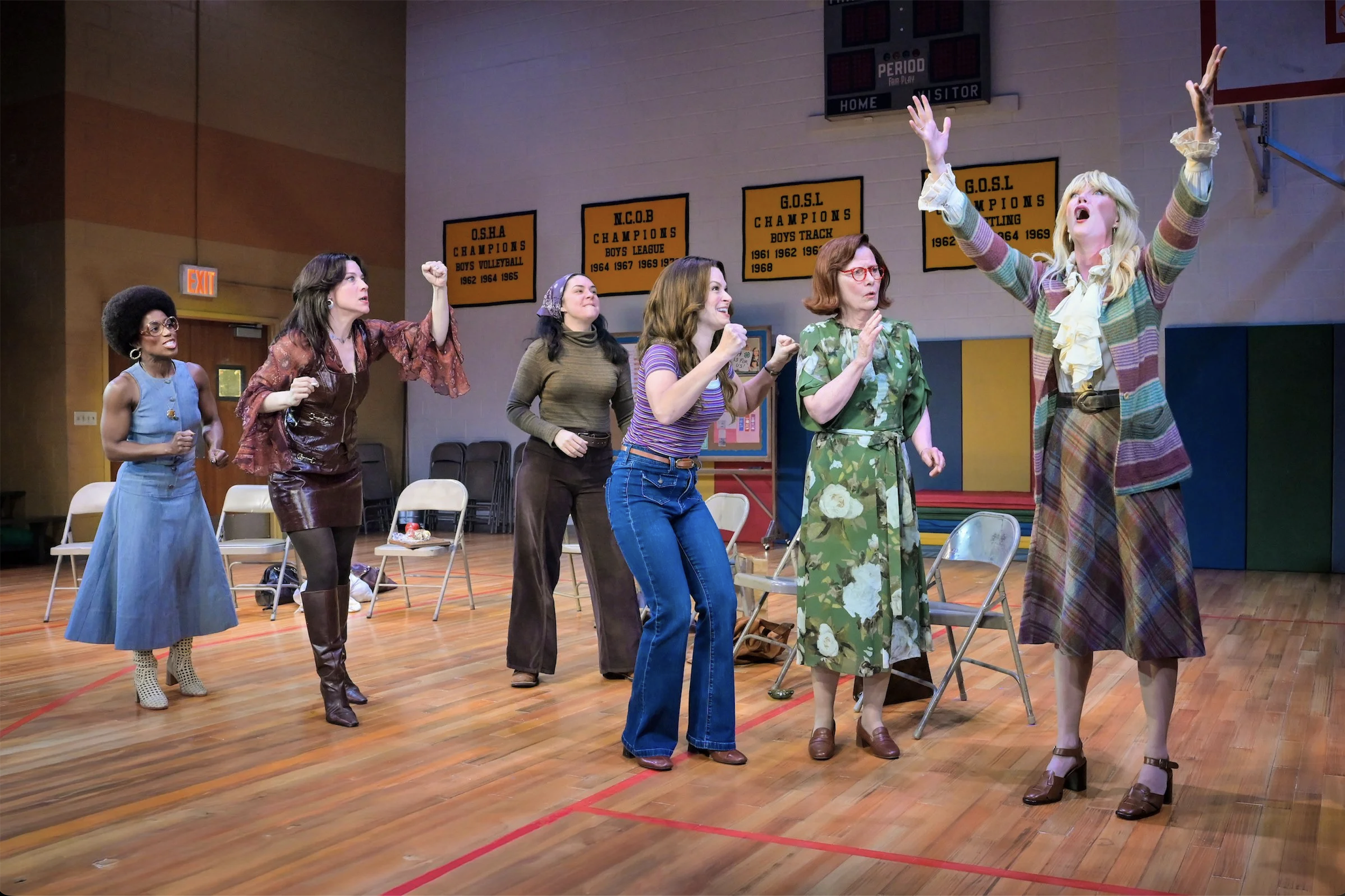
The cast of Bess Wohl’s Pulitzer Prize and Tony Award-winning play Liberation includes (from left) Felicia Curry as Celeste, Irene Sofia Lucio as Isidora, Evelyn Spahr as Susan, Katie Lowes as Lizzie, Mary Gordon Murray as Margie and Britt Faulkner as Dora. The Berkeley Repertory Theatre production continues through Nov. 29. Photo by Kevin Berne
My first impression of Liberation was a visual one. The play’s set, designed by David Zinn, is a basement basketball court in an Ohio rec center circa 1970. On the wall are banners proclaiming various championships, all by boys’ teams. On the day I saw Liberation at Berkeley Repertory Theatre, the Golden State Valkyries had celebrated their WNBA championship across the Bay with an ecstatic victory parade in front of thousands of adoring fans.
Things do change, however slowly or erratically. And that change happens because of women like those we meet in Bess Wohl’s Pulitzer Prize- and Tony Award-winning drama, women who are doing what they can to embrace the possibilities offered by the Women’s Liberation movement. They’re questioning the rules, who made the rules and who the rules ultimately serve. And in the process, they confront difficult things in each other and in themselves and in the world they’re trying to change.
There’s something deeply affecting about spending time with these seven women (and one token male – such a fun phrase to use). Strangers at the first meeting, they develop a process that works for them and spend the next few years, as they might put it, raising their consciousness, activating protests and supporting each other in ways most of them probably never expected. It should be noted, too, that the costumes by Qween Jean are thrillingly evocative of each character and the groovy ‘70s, with the festival of denim toward the end of the show especially effective.
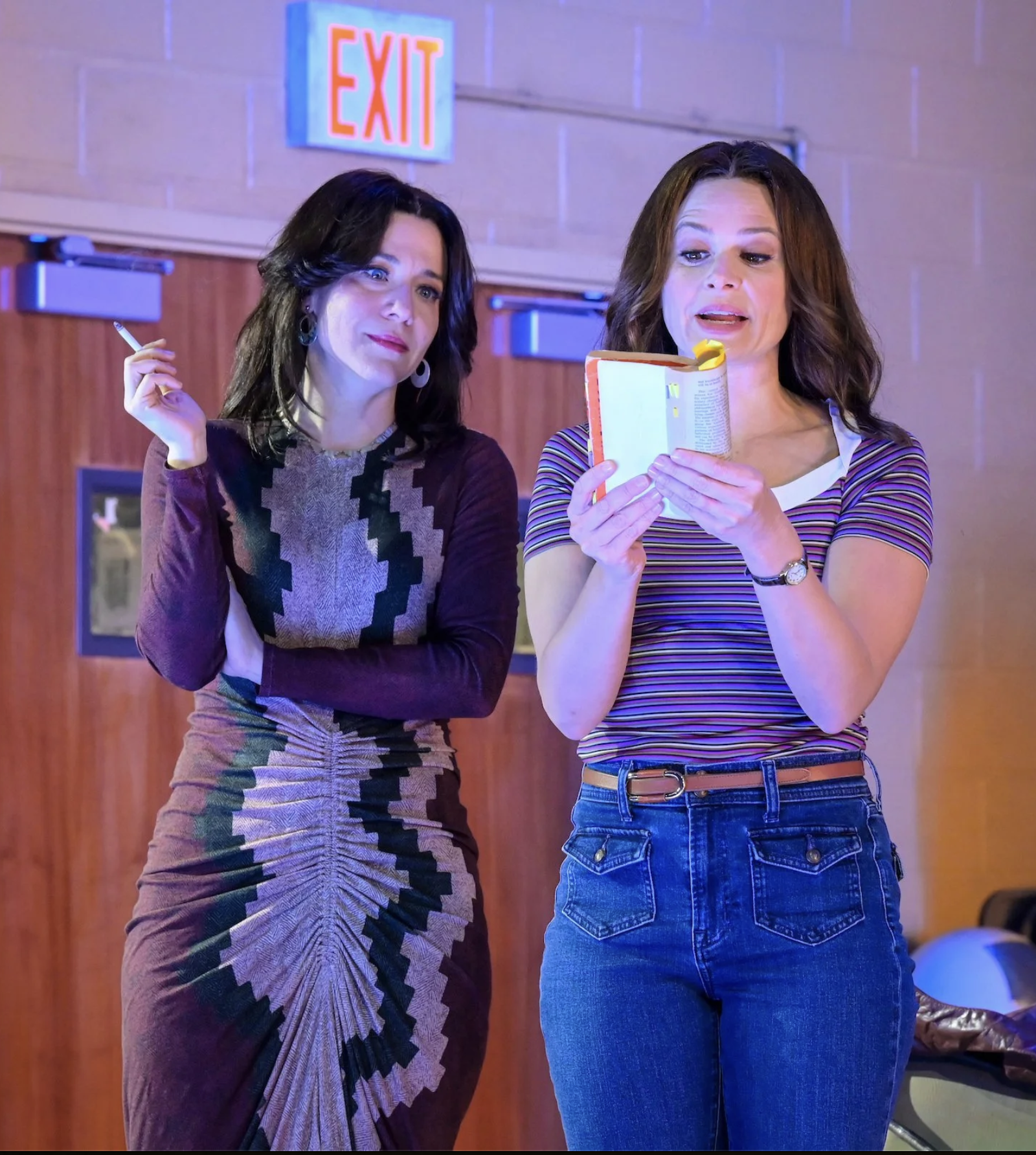
Irene Sofia Lucio is Isidora and Katie Lowes is Lizzie. Photo by Kevin Berne
Wohl and director Whitney White take a heart-on-their-sleeves approach to this story. It’s emotional and funny and very accessible, and the 2 1/2-hour show is at its best when we’re in the moment with the women creating a sort of activist family where notions of equality and empowerment bond them and, at times, agitate them.
White’s cast immediately draws us in and starts making us care about each character – where she’s coming from, why she’s there and what the conflicts and friendships lie ahead. There’s something incredibly satisfying in watching a group come together with a common goal. Their discussions of everything from sexual harassment (and actual assault) to family pressure to conform are powerfully moving and form the heart of the play.
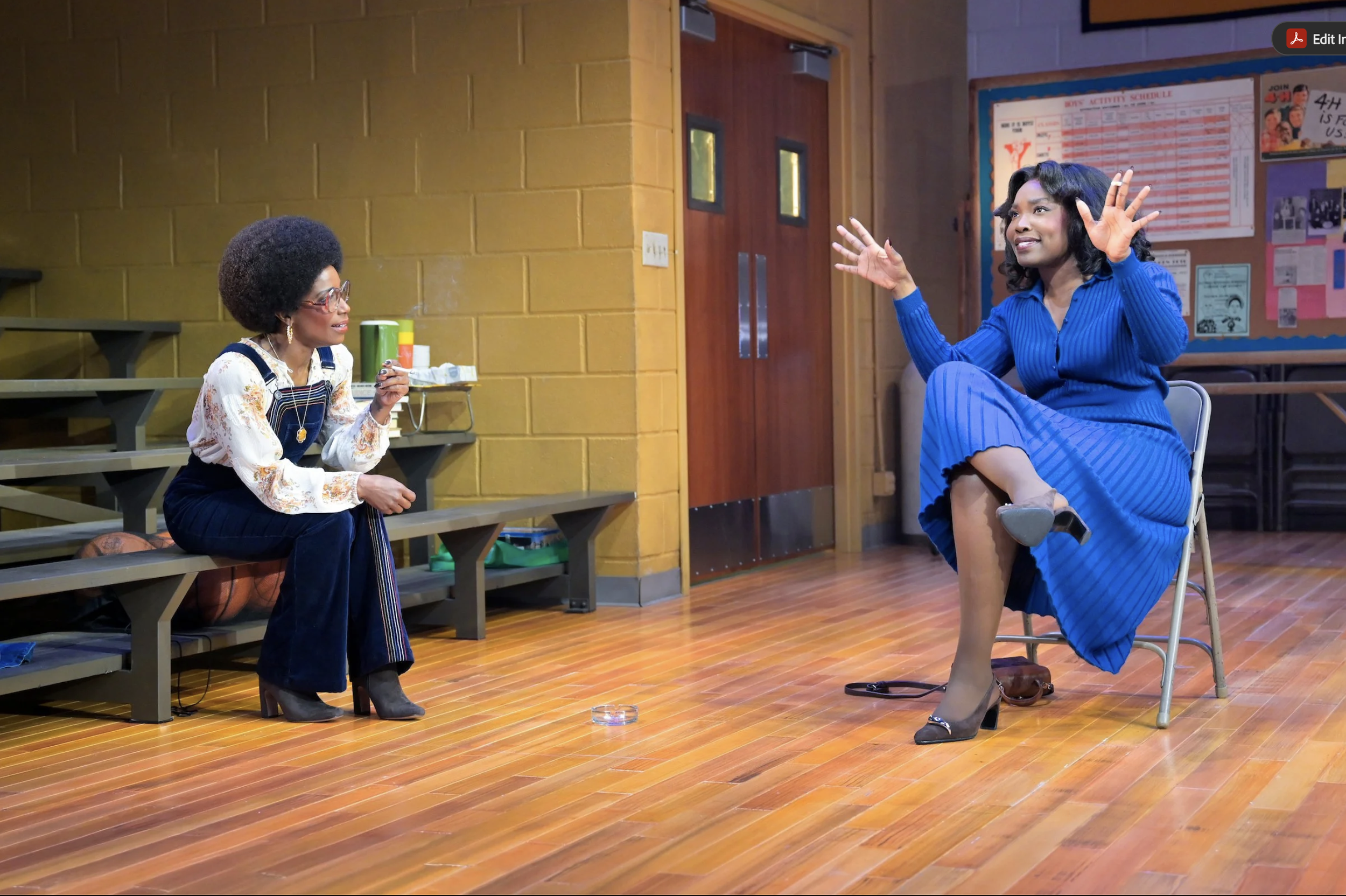
Felicia Curry (left) is Celeste and Veronica Otim is Joanne. Photo by Kevin Berne
The most talked-about scene – and the one that requires every audience member to power off their phones and put them in locked pouches – is when the women engage in a nude encounter session. On one hand you have brave actors doing this in front of an audience, and on the other, you have brave characters breaking out of their comfort zones in a major way in front of each other. The scene crackles with everything that nudity involves, but Wohl really makes it count emotionally, and it feels we’re right there with them, vulnerable, trusting, courageous and exhilarated.
What is less effective in Wohl’s writing is her use of a direct-address narrator: the daughter of one of the women in the group who then goes on to play her own mother (in most scenes, at least). This gives Wohl the ability to jump between the present and the past and continually break the fourth wall. Then, toward the end, she engineers what I will call her Our Town moment, when time and reality bend in a way that should be much more emotionally rewarding than it actually is.
In spite of the clunky framework, Liberation registers because of the women. When we meander too far into the story of the mother-daughter (both played by Katie Lowes), the narrative loses steam. I was particularly moved by Mary Gordon Murray as Margie, the group’s elder and a stay-at-home mom whose small rebellions feel like gargantuan triumphs, and by Evelyn Spahr as Susan, a captivating free spirit who feels more developed in performance than she does on the page.
Sadly, there’s a timeliness to almost everything in Liberation, both in the cultural sense and in the interpersonal sense. How do we come together to triumph and how do we fight and fail? When Celeste (the fantastic Felicia Curry) says, “A woman speaking uninterrupted is a radical act,” the heart just sinks. Why is that still true? What’s also true is that the work never ends. There’s another line in the play that reverberates across waves of feminism and across any attempt to battle injustice, and it’s Wohl’s simplest, most effective use of direct address: “You can take it from here.”
FOR MORE INFORMATION
Bess Wohl’s Liberation continues through Nov. 29 at Berkeley Repertory Theatre’s Roda Theatre, 2025 Addison St., Berkeley. Running time: 2 hours and 30 minutes (including intermission). Tickets are $25-$137 (subject to change). Call 510-647-2949 or visit berkeleyrep.org.