Chad Jones’ Theater Dogs

September 13, 2008

Review: `More Stories by Tobias Wolff’

Filed under: Tobias Wolff, Word for Word, local theater, theater review — Chad Jones @ 9:51 am


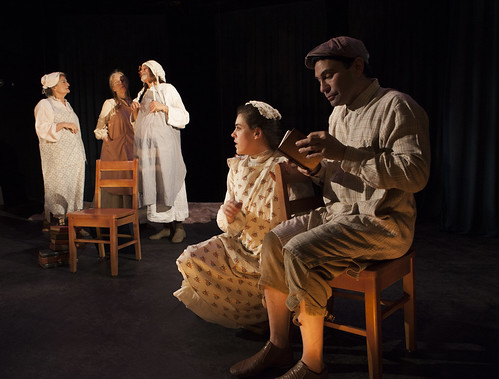
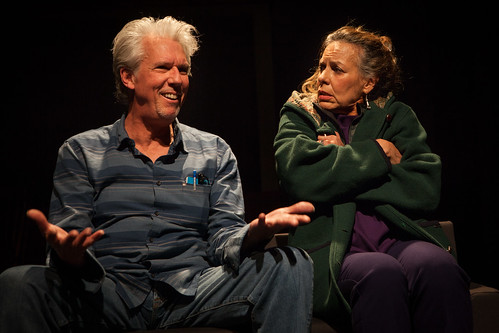
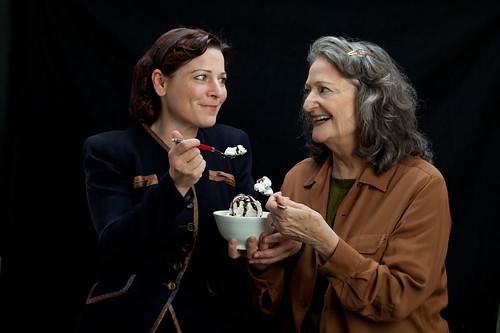
Anthony Nemirovsky is the son and Jeri Lynn Cohen is his mother in the Tobias Wolff short story “Firelight,” one of three stories in Word for Word’s More Stories by Tobias Wolff at San Francisco’s Magic Theatre. Photos by Clayton Lord


Word for Word remains hungry like the Wolff
««««

The particular alchemy of Word for Word and author Tobias Wolff is undeniable. Six years ago the venerable theater company, which adapts short works of fiction without changing a word of the original text, produced three Wolff short stories, and the result was a theatrical and literary explosion.

Something about Wolff’s deep humanity and understated flair seemed to expand and blossom under the stage lights and in the capable hands of the Word for Word team.

Wolff, happily, is back on stage with Word for Word in the appropriately named More Stories by Tobias Wolff, a trio of tales from the author’s latest short story collection, Our Story Begins: New and Selected Stories ($26.95, Knopf).

Joel Mullennix directs the stories, and a five-person cast brings them to delectable life on the stage of the Magic Theatre.

Each of the stories is so different, and yet there are threads that run through them – something wistful in the narrative – that helps the evening feel of a piece and underscores the tender, complex authenticity of Wolff’s writing.

“Sanity” opens the evening with two superb performances. Michelle Pava Mills as April, a high school girl worried about her father’s latest stint in a mental hospital and the effect it will have on her second stepmother’s willingness to remain in the family. And Stephanie Hunt is Claire, the cool, collected stepmother whose roiling inner life (not to mention her past) can barely be sensed outside her cool, gray suit and wide-brimmed black hat.

The two women, after visiting the mental hospital, have a long walk back to catch the bus (people in Wolff stories are more likely to take busses than drive cars), and during that walk, Wolff plunges deep into the essence of marriage, of age contrasting youth, of need rebuffed by being needed.

It’s a fascinating, surprising story with …

To read the complete review, please visit my Examiner.com theater page here.

More Stories by Tobias Wolff continues through Oct. 5 at the Magic Theatre, Building D, Fort Mason Center, Marina Boulevard and Buchanan Street, San Francisco. Tickets are $22-$40. Call 415-441-8822 or visit www.zspace.org.

February 9, 2008

Review: `Sonny’s Blues’

Opened Jan. 8, 2008,Lorraine Hansberry Theatre

Word for Word scores with jazzy Blues
three [1/2] stars Musical and muscular

First we see snapshots, glimpses of lives we have yet to understand. And we hear music. First the trumpet, then the bass, then the sax and, finally, piano.

More than a short story, which is how Sonny’s Blues began life at the pen of James Baldwin, and more than a play, which is what Sonny’s Blues has become through the efforts of Word for Word, what we are seeing is a jazz tone poem about love and creation.

Word for Word is consistently the most interesting and adventurous small theater company in the Bay Area. What could be an intellectual exercise — adapting short works of fiction to the stage without changing a word of the original text — becomes, in this company’s capable hands, becomes thrilling, emotionally involving theater.

And with director Margo Hall at the helm of Sonny’s Blues, the experience grows even further. Hall’s understanding of Baldwin’s 1957 work, set in Harlem in the ’50s, includes a deep sensitivity to the musical aspect of both the subject matter and Baldwin’s jazz-influenced writing.

To enhance these Blues, Hall recruited local jazz great Marcus Shelby to score play, and Shelby’s work here (performed via recording) is extraordinary in the way it heightens the already intense emotions of Baldwin’s story.

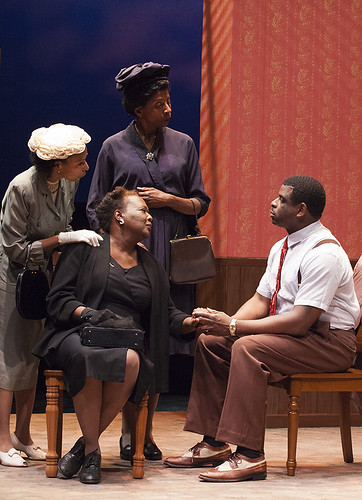
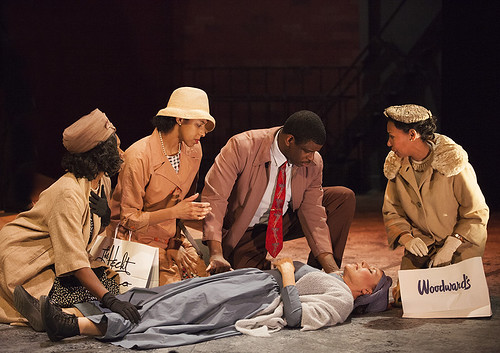
Music is a key part of the relationship between two brothers. A man known only as Brother (Peter Macon) has gone to school, served in the Army and settled into a high school teaching career with a wife (Allison L. Payne) and three children. His younger brother, Sonny (Da’Mon Vann), younger by seven years, has had a more difficult time of it, feeling restless and unable to fully channel his creativity.

As time goes on, Sonny, a jazz pianist, falls in with the wrong crowd, and the brothers’ relationship fractures. Brother always feels a sense of guilt because he promised his mother (Margarette Robinson) before she died that he would always keep an eye on Sonny. But Sonny has turned to drugs — heroin — and Brother wants no part of that.

After reading about Sonny’s arrest in the newspaper, Brother reestablishes contact with his little brother, and when Sonny gets out of jail, the two men begin the tricky dance of actually being brothers to one another. This means that Sonny must somehow make Brother understand what it means to play and create music.

When Brother does start to come around, it inspires some of Baldwin’s most beautiful writing: “All I know about music is that not many people ever really hear it. And even then, on the rare occasions when something opens within, and the music enters, what we mainly hear, or hear corroborated, are personal, private, vanishing evocations.”

Baldwin is wise enough not to offer a pat happy ending, but he does offer understanding and love and creativity at their most emotionally vulnerable.

Hall’s production is first rate. Her ensemble, which also includes Mujahid Abdul-Rashid and Robert Hampton, is fluid and capable of playing anything from a small child (Hampton) to a fireplug of a jazz player (Robinson).

In true Word for Word fashion, Sonny’s Blues is a triumph on all levels. The production itself — with a spare, efficient set by Lisa Dent and moody lights by Tom Ontiveros – is strong, the performances are solid and the text, already muscular and evocative, becomes even more so when brought to life.

But it’s Shelby’s music that puts the show over the edge. You can’t have Sonny’s Blues without real blues in your ears, and between Baldwin’s words and Shelby’s music, these Blues translate to bliss.

Sonny’s Blues continues through March 2 at the Lorraine Hansberry Theatre, 620 Sutter St., San Francisco. Tickets are $22-$36. Call 415-474-8800 or visit www.lhtsf.org or www.zspace.org.

Special event:
On Feb. 15, Marcus Shelby will perform live, with vocals by Miss Faye Carol. The event begins with a pre-show reception at 7:30 p.m. and the gala party afterward. Tickets are $95.

February 6, 2008

Margo Hall gets the `Blues’

You’re forgiven if you didn’t know quite how amazing Margo Hall is.

If you’re a regular Bay Area theatergoer, you already know that Hall is an extraordinary actor. Last year, for instance, she reprised the character Fe in Campo Santo/Intersection for the Arts’ Fe in the Desert and gave one of the year’s best performances.

But Hall is also an accomplished director. She was one of the creative collaborators and one of the performers in Berkeley Repertory Theatre’s award-winning docudrama The People’s Temple, and last year she co-directed Shotgun Players’ excellent Bulrusher at the Ashby Stage.

Surprisingly, Hall says she prefers directing to acting.

“I say that when I’m directing,” Hall says. “I do love acting, but there’s something so fun, so freeing about directing.”

And one of Hall’s favorite directing gigs is for Word for Word, the San Francisco company that does amazing work turning short works of fiction into fully staged theater pieces without changing a word of the original text.

With Word for Word, Hall has been both performer (Langston Hughes’ The Blues I’m Playing, Barbara Kingsolver’s Rose-Johnny, Zora Neale Hurston’s The Gilded Six Bits) and director (Alice Munro’s Friend of My Youth, Greg Sarris’ Joy Ride).

She finds herself back in the Word for Word director’s chair for James Baldwin’s Sonny’s Blues, which opens tonight at San Francisco’s Lorraine Hansberry Theatre.

Baldwin’s story, published in 1957 and collected in the 1965 book, Going to Meet the Man, follows two brothers in 1950s Harlem. One is a schoolteacher and family man. The other is a jazz pianist with a troubled past.

Hall, who grew up in Detroit and now lives in Oakland with her husband, the actor L. Peter Callender, and their 12-year-old son, reread the story and responded to it immediately.

“Visualizing the piece wasn’t difficult,” Hall says on the phone from her home. “Ever since I’ve worked with Word for Word I can’t read a story without visualizing it. I didn’t visualize the story’s opening moment right away — that took some time. But I clearly saw other parts.”
The story’s jazz milieu was a natural for Hall, whose stepfather was a jazz musician.

“I was exposed to Sonny Rollins and a whole lot of other jazz cats,” Hall says. “I was familiar with the world of be-bop. My dad’s 15-piece band rehearsed in our basement. When I was rereading the story, this music, these people — Charlie Parker, Bird – I just knew it. It was familiar. I could hear the music and everything. It was really exciting.”

With jazz music so prominent in the story, Hall had to decide how to handle music in the production. Should there be live music? Should the actors play instruments themselves? At first, Hall considered casting her friend, the actor and beat-boxer Tommy Shepherd, but then she decided to go for the full jazz sound.

She approached her friend and previous collaborator Marcus Shelby, a prominent Bay Area jazz musician.

“I knew Marcus would know this story, this world,” Hall says. “The more we talked about the show and the score, the more I talked about the sounds in the show — the traffic, the subway — all being created by instruments in a very stylized way.”

Ideally, Shelby and his band would be playing live for each performance, but Hall says that would have required more time in an already crowded rehearsal schedule, so the score is recorded. But on Feb. 15, after the performance, Shelby will perform the music live at a gala reception.

One of the most extraordinary (and most consistent) things about Word for Word is the company’s skill at making literature come to life in surprising ways that enhance the story. The experience of seeing a Word for Word show is often as rich as reading and as thrilling as live theater because the show is, quite literally, both.

For Hall, the key to a good adaptation is transformation.

“It’s easy to put the story up, make it narrative and let the audience enjoy the beautiful language,” she says. “But capture the essence of the story is hard. We as the creative team have to go so deep that the audience can see the transformation and get a true, honest sense of what the story is when they leave.”

The more narration in a story, the harder it is to stage. Not surprisingly, if a story has a lot of dialogue, it’s fairly easy. Sonny’s Blues lands more on the narration-heavy end of that scale.

When Hall directed Friend of My Youth, another narrative-heavy story, she elected to direct her actors away from talking directly to the audience.

“This time, I went, `No, I’m gonna do it.’ The actors should definitely address the audience,” Hall explains. “This story is so universal — it’s about relationships and siblings. One is this conservative guy who went to school and became a teacher. Most of the audience will relate to him. Let’s have him talk to the audience, then get back into the scenes. This gives me as a director the opportunity to make bold choices.”

Next up for Hall: directing a solo show by Ariel Lucky, Free Land, about his family’s pioneer history and interactions with American Indians. She’s also continuing to teach at Chabot College (“I love my kids…they lift me up with their zaniness”) and being a mom.

“My son is a computer genius,” she says. “He has his own computer business and Web site. He fixes computers. He loves reading Shakespeare, but he wants to be a CEO.”

Sonny’s Blues continues through March 2 at the Lorraine Hansberry Theatre, 620 Sutter St., San Francisco. Shows are at 8 p.m. Wednesdays-Saturdays; 2 p.m. Sundays. Tickets are $22-$36. Call 415-474-8800 or visit www.lhtsf.org or www.zspace.org.

December 27, 2007

2007 theater Top 10

I can always tell whether a theater year has been good or not so good when I sit down to hammer out my Top 10 list. If I can summon five or more shows simply from memory, it’s a good year. This year’s entire list came almost entirely from memory (which is a feat in itself as the old noggin’ ain’t what it used to be), so it was a good year indeed.

Here’s the countdown leading to my No. 1 pick of the year.

10. Anna Bella Eema, Crowded Fire Theatre Company — Three fantastic actresses, Cassie Beck, Danielle Levin and Julie Kurtz, brought Lisa D’Amour’s tone poem of a play to thrilling life.

9. First Person Shooter, SF Playhouse and Playground – What a good year for SF Playhouse. This original play by local writer Aaron Loeb brought some powerhouse drama to its examination of violent video games and school violence.

8. Bulrusher, Shotgun Players – Berkeley’s own Eisa Davis’ eloquent play, a finalist for the Pulitzer Prize for drama, turned the Northern California dialect of Boontling into poetic drama as it told the story of an outcast young woman finding her place in the world.

7. Avenue Q, Best of Broadway/SHN – Hilarious and irreverent, this puppet-filled musical by Jeff Marx, Robert Lopez and Jeff Whitty made you believe in friendship, life after college and the joys of puppet sex.

6. Jesus Hopped the `A’ Train, SF Playhouse – It took a while for Stephen Adly Guirgis’ intense drama to make it to the Bay Area, but the wait was worth it, if only for Berkeley resident Carl Lumbly in the central role of a murderer who may have seen the error of his ways. And note: This is the second SF Playhouse show on the list.

5. Emma, TheatreWorks _ Paul Gordon’s sumptuous, funny and, of course, romantic adaptation of Jane Austen’s novel came marvelously to life as a musical, with a star-making performance by Pleasanton native Lianne Marie Dobbs.

4. Argonautika, Berkeley Repertory Theatre _ Mary Zimmerman’s athletic retelling of the Jason and the Argonauts myth fused beauty and muscle and impeccable storytelling into a grand evening of theater.

3. Which Is More Than I Can Say About Some People, Word for Word – Actually, the second half of Strangers We Know, this stage adaptation of Lorrie Moore’s short story was brilliantly directed by Joel Mullenix and performed by Patricia Silver and Sheila Balter.

2. Man and Superman, California Shakespeare Theater _ This unbelievably vivid version of George Bernard Shaw’s massive existentialist comedy benefited from superior direction by Jonathan Moscone and an impeccable cast headed by Elijah Alexander and Susannah Livingston.

1. The Crowd You’re in With, Magic Theatre _ The team of playwright Rebecca Gilman and director Amy Glazer fused into brilliance with this slice-of-life meditation on why we make the choices we make in our lives. Local luminaries Lorri Holt and Charles Shaw Robinson brought incredible humor and tenderness to their roles, and T. Edward Webster in the lead managed to make ambivalence compelling.

Now it’s your turn. Please post your favorite theater moments of 2007 — no geographical limitations, just good theater.

October 18, 2007

Murakami’s `quake’ rattles Berkeley Rep

Opened Oct. 17, 2007 at Berkeley Repertory Theatre’s Thrust Stage

Galati translates Murakami stories to the stage
Three stars Stirred, not shaken

We’re lucky to live in the Bay Area for many reasons, the quality and bounty of theater chief among them.

When our theater companies aren’t producing interesting shows themselves, chances are they’re importing good stuff from elsewhere. That’s the case with Berkeley Repertory Theatre’s new show, after the quake, which opened Wednesday on the Thrust Stage.

The show originated at Chicago’s Steppenwolf Theatre Company and is presented here as a co-production with the La Jolla Playhouse. You might call this Part 1 of a two-part mini-Chicago festival. Berkeley Rep’s next show is Mary Zimmerman’s Argonautika, which hails from Chicago’s Lookingglass Theatre Company.

Pulling shows from other places seems especially relevant in the case of after the quake, a theater piece created from fiction. Japanese writer Haruki Murakami’s after the quake deals with the aftermath of the devastating 1995 earthquake in Kobe, Japan.

For the stage version, Galati, an avowed Murakami devote, takes two of the book’s stories and creates an 80-minute play that, for all its theatrical artistry, still feels like a piece of literature.

Getting back to the “lucky to be in the Bay Area” thing, one of our great companies is Word for Word, the company that turns short fiction into fully staged theater pieces without altering the original text. Well, Galati’s after the quake, which has been more liberally adapted, is beautiful but not on par with Word for Word’s best work (Stories by Tobias Wolff comes immediately to mind).

What’s missing is the theatrical thrill, the excitement of crackling good writing coming alive and becoming something more than just writing.

There are certainly moments in “quake” that reverberate. Most come from the story “Superfrog Saves Tokyo,” in which an action-hero frog (Keong Sim), shows up the home of a mild-mannered loan officer (Paul H. Juhn) to enlist his help in fighting the Worm, an underground villain that absorbs hatred, gets angry and makes earthquakes.

Sim, in his three-piece suit, green gloves and green sunglasses (costumes by Mara Blumenfeld), is a wonderfully droll frog who takes the saving of lives very seriously, and Juhn is just as good as the average Joe who rises to the challenge of being a heroic sidekick.

The other story, “Honey Pie,” is a sweet love story that aims to be something more but falls short, at least in theatrical terms. On the page, with time to muse and decipher, the story may reveal more depth.

Junpei (Hanson Tse), Sayoko (Jennifer Shin) and Takatsuki (Juhn) were inseparable in college until two sides of their friendly triangle fell in love, leaving the third side feeling lonely and rejected.

Years later, Sayoko and Takatsuki are the divorced parents of a little girl, Sala (Madison Logan V. Phan on opening night, alternating in the role with Gemma Megumi Fa-Kaji), whose dreams are invaded by a creature she calls “earthquake man.”

The only thing that seems to calm the girl is a bedtime story from her mom’s old friend, Junpei, a short story writer by trade. He tells her about clever bears and other bears who miss their chances.

Notions of anxiety, safety and finding equilibrium on shifting grounds course through each of the stories, but aside from the fact that “Superfrog” is one of Junpei’s short story creations, the connection between them does not come through strongly, thus giving the brief evening a somewhat incomplete feel.

Still, there’s plenty to enjoy, from Galati’s simple, fluid staging on James Schuette’s dark, elegant set (think of a hip advertising agency lobby beautifully lit by James F. Ingalls), to the warm, charming performances from the cast. Best of all is the live music performed by Jason McDermott on cello and Jeff Wichmann on koto (a stringed instrument that, like the accordion does for Paris, immediately conjures Japan). In addition to the original compositions by Andre Pluess and Ben Sussman, the duo also manages to work in the Beatles’ “Norwegian Wood” and “You Light Up My Life.”

after the quake ends up being a more intellectual pleasure than an emotional theatrical experience — sort of like a good short story compared to a big, juicy novel.

For information about after the quake, visit www.berkeleyrep.org.

August 14, 2007

Review: `Angel Face’

Filed under: Word for Word, Z Space Studio, backstage, local theater, plays, theater review — Chad Jones @ 2:28 pm

Opened Aug. 10 at Project Artaud Theatre, San Francisco

Noir thriller `Angel Face’ gets a tough-talking Word for Word treatment
Three stars Hard boiled

Dames don’t come much more hardboiled than Jerry Wheeler. Back in the day she used to strut her stuff in a rhinestone g-string and they called her Honey Sebastian. Jerry knows her way around the tough, gangster-ridden streets of New York City, and the stone cold tone in her voice lets you know she’s not going to take any guff.

In other words, Jerry is sort of a female Philip Marlowe except she falls into the gumshoe business by accident when her kid brother, Chick, gets framed for murdering some doll who had underworld connections.

Jerry uses all her smarts – not to mention the assistance of a soft-hearted detective – to clear her brother’s name.

That, in a noirish nutshell, is the plot of Cornell Woolrich’s 1937 story Angel Face, which has been brought to shadowy, tough-guy life by Word for Word, the San Francisco company that turns short works of fiction into full-blooded pieces of theater.

It’s an interesting experiment, as director Stephanie Hunt finds ways to exploit the noir genre – brought so vividly to life in films of the 1930s and ‘40s – onstage. Sometimes Word for Word’s adaptations revel in their cleverness as simple narrative sentences become wonderful bits of stage business.

But for Angel Face, Hunt plays it pretty straight, and though all the “he saids’’ and “she saids’’ are all in place, the story unfolds with the precision of a movie script. The emphasis is on the genre dialogue, which evokes an entire era all by itself. Try these on for size: “That girl was murdered sure as I was born to shut a mouth.’’ “I’ve hocked everything I own up to my vaccination mark.”

Hunt has assembled an enthusiastic cast that embraces the noir conventions – fedoras askew, enticing evening gowns, finding the spot between the shadow and the light – and revels in Woolrich’s dialogue from the mean streets circa 1937.

Laura Lowry is Jerry Wheeler, the former burlesque girl now on the hunt for a killer in an attempt to save her brother (the ever-reliable Danny Wolohan) from the electric chair. Lowry has the good looks that make us understand how she gets away with her new nickname, “Angel Face,’’ and her tough exterior masks, of course, a heart that longs for the better, more wholesome things in life.

Hot on the trail of the real killer, Jerry initially resists the help of Detective Nick Burns (John Flanagan), but he’s a good guy, and she eventually succumbs to his charms – and his able assistance. He gets her out of a pickle or two.

Pulpy and fun, Angel Face doesn’t really want to be taken seriously as a story. We don’t exactly care about the characters or get to know them with any depth. But we’re carried along by the plot, which involves paid-off servants, nightclub magnates, thugs in zoot suits and maraca-shaking showgirls with bananas on their heads.

The Project Artaud Theater is enormous, and though the story has scope, it suffers from a lack of intimacy. It’d be great if we could see Lowry’s angel face up close. But set designer Mikiko Uesugi does her best to fill the cavernous space with a multi-level set that catches Thomas Ontiveros in appropriately shadowy ways.

The hardworking cast members, who play multiple roles with ease, include Morgan Voellger (as the wonderfully named Ruby Rose Reading), Michael Patrick Gaffney (as a brutish detective, a fey auctioneer, a nightclub manager and a gangster sidekick), Casey Jones Bastiaans (as a double-crossing maid, a calypso singer, a grieving old woman and a hunched-over piano player) and Paul Finocchiaro (as a sleazy gangster kingpin).

It’s funny, but Angel Face, because it is a well-done resurrection of the noir genre, ends up feeling less like a story, or even a play, and more like a movie you’d watch on Turner Classic Movies on a rainy Saturday night.

For information about Angel Face, visit www.zspace.org/angelface.htm.

January 14, 2007

Review: Word for Word’s “Strangers We Know”

Filed under: Word for Word, backstage, local theater, plays, theater review — Chad Jones @ 11:22 am

(opened Jan. 12, 2007)

three stars More Moore

For 13 years now, Word for Word has offered a different sort of book club.

The members — let’s call them “the audience” — all read the same works of fiction, just like in any other book club. But in the case of Word for Word, the process of reading is a little different.

You buy a ticket, head into a theater and, rather than being confined to a page, the words live and breathe on stage. You might say you’re being read to by actors, but a Word for Word show is much more than that. In translating short stories (or chapters of novels) for the stage without changing a word of the original text, the Word for Word wizards also manage to create fully formed, beautifully staged pieces of theater.

The latest Word for Word show, Strangers We Know, which opened Saturday at San Francisco’s Magic Theatre, offers two short stories that originally appeared in the New Yorker in 1993: Mavis Gallant’s “Mlle. Dias de Corta” and Lorrie Moore’s “Which Is More Than I Can Say About Some People.”

Sharp and elegant in their writing, the stories are wildly different and demonstrate the dangers and pleasures of stage vs. page.

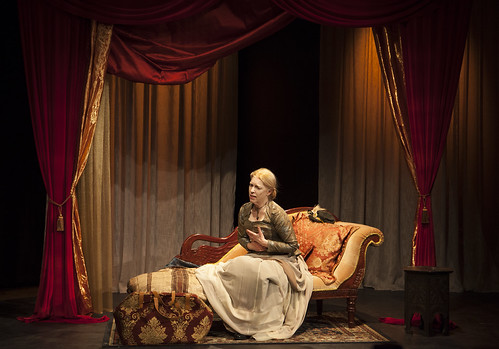
Gallant’s 40-minute opener (right) is a first-person tale addressed to the absent title character.
Susan Harloe (a Word for Word co-founder) plays a Parisian widow recalling a brief period years ago in which she took in a boarder, a struggling young actress named Alda Dias de Corta (Maria Candelaria).

Gallant’s story, though full of pithy observation (“Some people think the man she lives with is her son. If so, she had him at the age of 12.”), is highly undramatic and spends too much time detailing a bad TV movie starring the young actress. Director Amy Kossow employs the usual Word for Word cleverness in the staging as the ensemble plays everything from yapping neighbor dogs to shelves holding luggage.

But there’s no arc. The central character _ unattractively costumed and wigged by Ambra Sultzbaugh _ never comes across as more than a lonely French snob to whom vowels and rolled r’s are of the utmost importance. There’s little development and no real plot.

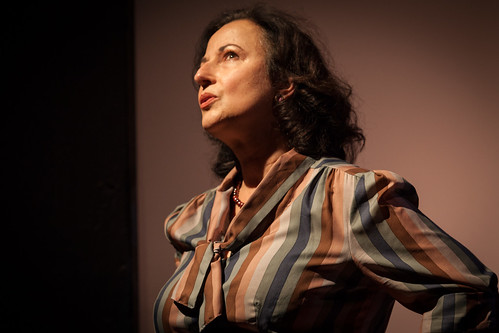
The exact opposite is true of Moore’s wonderful “Which Is More Than I Can Say About Some People,” (below) the story of a middle-age daughter, Abby (Sheila Balter) and her mother, Mrs. Mallon (Patricia Silver) as they take a driving vacation through Ireland.

Moore’s abundant humor and sardonic tone are captured perfectly in Balter’s nuanced performance, but Silver (a Word for Word regular) is a revelation as the domineering mother who’s not quite as wise or as fearless as she pretends to be.
Photobucket - Video and Image Hosting
“Once you’re with a man,” the mother instructs, “you have to sit with him. As scary as it seems. You have to be brave and learn to reap the benefits of inertia.”

Moore’s incisive story takes us through thorny mother-daughter issues, marriage troubles and that particularly fascinating rite of passage when parents cease being parents and become flawed _ though lovable _ human beings.

The story culminates in the kissing of the Blarney Stone, which is much more difficult than you might imagine. Apparently you have to lie on your back while holding two iron bars and scoot under the stone in such a way that you’re practically hanging off the wall.

Well staged by director Joel Mullenix (who also plays a hilariously fey poet earlier in the piece), “Which Is More Than I Can Say” is Word for Word at its best: a great story made even greater by a robust yet sensitive adaptation to the stage that makes you wonder if, however secretly or unconsciously, the author really intended it for Word for Word’s theatrical book club all along.

Strangers We Know continues through Jan. 28 at the Magic Theatre, Building D, Fort Mason Center, Marina Boulevard at Buchanan Street, San Francisco. Visit www.zspace.org for information. Note: Show moves to the Julia Morgan Center for the Arts, 2640 College Ave., Berkeley Jan. 31-Feb. 4

December 23, 2006

Tip-top ten

Happy holidays, Theater Dogs!

Thanks for reading the blog in 2006. I’ll try to make it bigger, better, funnier and fresher in 2007.

Below you’ll find my Top 10 list of favorite theater experiences in 2006. I’d love for you all to share some of your favorites as well, so use the comment feature liberally.

1.The Clean House,TheatreWorks

Sarah Ruhl’s immaculate play — is it a comic drama or a dramatic comedy? — reveals a writer so attuned to the human heart that her work may actually be beneficial to your health. This production, helmed by Juliette Carrillo, sure was. Love is a mess, Ruhl tells us. It’s dirty (like a good joke), messy and, at its best, like really good homemade chocolate ice cream.

2. The Glass Menagerie, Berkeley Repertory Theatre

The news that Rita Moreno, the Bay Area’s resident living legend, would tackle the role of Amanda in this Tennessee Williams classic was intriguing. Could Moreno handle it? Anyone who doubted Moreno’s chops was quickly proven wrong by her powerhouse portrayal of a mother desperate to see her children succeed in a harsh world. Director Les Waters gave us such a fresh approach to the play that it almost seemed newly minted.

3. Love Is a Dream House in Lorin, Shotgun Players

Playwright Marcus Gardley did a magnificent thing with this world-premiere play: He turned a neighborhood into art, and in doing so made the specific universal. Gardley immersed himself in the history of Berkeley’s Lorin District — from the recent past clear back to Native American days — and, with the help of director Aaron Davidman, managed to capture something significant about each era leading up to the present. The cast of more than 30 professionals and nonprofessionals found the heart of the piece and showed us over and over again that without community, we’re not much.

4. Hunter Gatherers, Killing My Lobster

Of all this year’s comedies, Peter Sinn Nachtrieb’s world premiere for sketch troupe Killing My Lobster was the meatiest. Maybe it had something to do with the onstage slaughter of a lamb at the play’s start. Or maybe it was the huge chunk of roasted meat that factors into the play’s bloody end. Whatever, this was an aggressively funny play about our primal, cave-man impulses, man’s need to hump (or kill) everything in sight and woman’s need for chocolate.

5. 4 Adverbs, Word for Word

San Francisco’s Daniel Handler (aka Lemony Snicket) ended his “Series of Unfortunate Events” books this year, but not before releasing a book under his own name. Four chapters of that book (Adverbs) became the basis for a typically wondrous production by Word for Word, the company that translates short fiction to the stage without changing a word of the original text. Kind of makes you glad Lemony Snicket is taking a break.

6. Dessa Rose, TheatreWorks

A musical about slavery sounds like a glum proposition, but in the hands of composers Lynn Ahrens and Stephen Flaherty, glum turns into serious, which turns into transcendent. Based on the novel by Sherley Anne Williams, the story of an escaped slave and the slave owner she reluctantly befriends bears the weight of history and the healing power of music.

7. In On It, Encore Theatre Company

Canadian playwright/director Daniel MacIvor’s work isn’t that well-known south of our northern border, but based on this dynamic, beautifully directed and performed piece,
MacIvor should be in demand. Actors Ian Scott McGregor and Glenn Peters broke the fourth wall, bent time and concealed key details as they told us the story of actors who used to be lovers working on a play about their relationship. Or were they?

8. Gem of the Ocean, American Conservatory Theater

The late August Wilson received a beautiful valedictory production of his second-to-last play from ACT and director Ruben Santiago-Hudson. The electric jolt of Wilson’s language — “So, live!” are the play’s final words — coursed through the nearly three-hour show, but the sturdy cast, headed by Michele Shay as Aunt Ester, made it very much alive.

9. Restoration Comedy, California Shakespeare Theater
San Francisco writer Amy Freed’s effervescent comedy is based on two 17th-century comedies that wished they could have been this fresh and funny. Special mention must be made of the hilarious Danny Scheie, who played Sir Novelty Fashion who later becomes Lord Foppington, the star of the show-stopping Act 2 fashion show (Anna R. Oliver provided the costumes).

10. Permanent Collection, Aurora Theatre Company

This serious drama about race relations by Thomas Gibbons veered into polemics, but before it did, the battle between a black man and a white man over a collection of art is humane, disturbing and, best of all, thought provoking.

The best shows that didn’t necessarily originate here (or were on their way somewhere else — like Broadway) include: Jersey Boys (Best of Broadway/SHN); A Chorus Line (Best of Broadway/SHN); The Miser (Berkeley Repertory Theatre/Theatre de la Jeune Lune); The Light in the Piazza (Best of Broadway/SHN); The 25th Annual Putnam County Spelling Bee (Stone, Nederlander, Barrington Stage Company et al); Swan Lake (Best of Broadway/SHN).

For more 2006 highlights, check out Jones for Theater.

OK. Now you…