Chad Jones’ Theater Dogs

April 30, 2009

Come on I wanna Leia: Fisher lands on Broadway

Another week, another Berkeley Repertory Theatre show going to Broadway.

Carrie Fisher’s autobiographical solo show Wishful Drinking, directed by Berkeley Rep artistic director Tony Taccone, will open in October at — where else? — Studio 54, where it runs through Jan. 3. The show is produced by Roundabout Theatre Company in association with Jonathan Reinis, Jamie Cesa, Eva Price, and Berkeley Rep.

This is the fourth show to head from Berkeley to Broadway in the last four years: Sarah Jones’ Bridge & Tunnel (2006), Stew’s Passing Strange (2008), and Sarah Ruhl’s In the Next Room (or The Vibrator Play) (2009). It’s also the 12th show in as many years to make the West to East transition. The list includes Danny Hoch’s Taking Over (2008), Ruhl’s Eurydice (2007), Tony Kushner and Maurice Sendak’s Brundibar (2006), Naomi Iizuka’s 36 Views (2002), Mary Zimmerman’s Metamorphoses (2001), Hoch’s Jails, Hospitals & Hip-Hop (1998), Anne Galjour’s Alligator Tales (1997), and Philip Kan Gotanda’s Ballad of Yachiyo (1997).

“This is the culmination of a long process,” Taccone said in a statement. “Berkeley Rep has a history of developing new work and, with our commissioning program, continues its commitment to bring fresh ideas and alternative viewpoints to the stage. I am pleased with the success of this project, and honored to collaborate with all of the people involved to bring this show to Broadway. It has been truly gratifying in recent years to see our shows reach a wider audience in New York, Los Angeles, London, and other cities.”

Visit www.roundabouttheatre.org for Wishful Drinking ticket information.

October 8, 2008

Good deed lands `Angels’ wings in museum

Filed under: Museum of Performance & Design, Sandra Woodall, Tony Kushner — Chad Jones @ 12:43 pm

Here’s an inspiring story that comes from the folks at The Museum of Performance & Design in San Francisco, who recently came to the rescue of set and costume designer Sandra Woodall after she was evicted from the studio she had worked in for the past forty years.

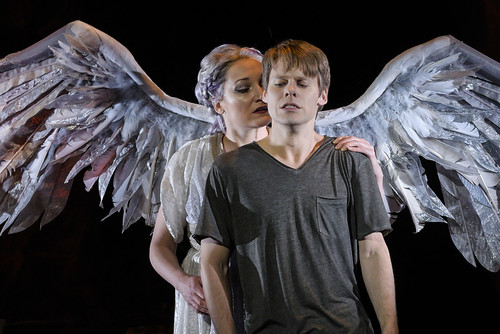
With very little notice, Woodall, an internationally renowned designer whose work includes the world premiere of Tony Kushner’s Angels in America in 1991 at the Eureka Theatre (seen at right), was desperate to find a home for over 180 boxes and containers of sketches, designs and costumes from throughout her career.

The Museum of Performance & Design, which has a long-standing relationship with Woodall and has exhibited her work, was delighted to have the designer establish her archive at the Museum. Among many items now joining the Museum’s collection is the original set of “wings” used in Angels in America, which the Museum is hoping to display in a future exhibition.

Woodall will work closely with the Museum to catalog and process the archive, which is not only a treasure-trove of Bay Area theater and dance from the past four decades, but also includes international designs Woodall has created for the Bolshoi Ballet and other world-class companies.

The Museum of Performance and Design (formerly the San Francisco Performing Arts Library and Museum) is in the Veterans Building, Fourth Floor, 401 Van Ness Ave., San Francisco.
Visit www.sfpalm.org for information

September 1, 2008

Itamar Moses goes back to high school

Writing about his high school experience proved therapeutic for playwright Itamar Moses, a Berkeley native whose Yellowjackets has its world premiere this week at Berkeley Repertory Theatre.

The 30-year-old writer headed back to the year 1994 to dramatically reconstruct his junior year at Berkeley High School, when he was editor of the school newspaper, The Jacket, and racial tensions were dividing the student body.

“High school is a potent time,” Moses says one morning before a rehearsal. “I try to examine why that is on this canvas. I was able to work out specific feelings here, and it’s amazing to me to discover that I did have a different perspective. I had such firm beliefs at the time, but I could actually see a more complex, multiplicity of viewpoints I didn’t have at the time. Things seemed so obvious to me as a student who was feeling threatened or getting messed with. I always hoped I’d see a larger perspective. I’m amazed I actually did.”

Moses, who now lives in Brooklyn’s Park Slope area, says that even though he was re-creating experiences of 14 years ago, he could hear the voices clearly.

“I feel like I still talk like I did in high school,” Moses says and laughs. “The other voices in the play, the ones that aren’t mine, I’ve been hearing for years. As opposed to just crafting dialogue, I tried to hear it. I have voices in there” – he points to his head – “not in a mental health way, but in a historical way.”

Some of those voices belong to African-American and Latino characters, which required Moses to write outside his race.

“Sure, there was an element of fear of fraudulence,” he says. “I did feel an internal hurdle. Am I entitled to do this? Is this OK? Solution was to remind myself that my choices were to do it or not write about Berkeley High at all. Usually that’s how to get yourself to do something difficult: get to the point where there’s no alternative. I guess I have the same feeling about writing female characters. In a weird way, you let go of the idea you’re writing from the outside in. Characters have to come from the inside out or they’ll play that way on stage. Every character is a fragment of your psyche, no matter the race or gender.”

Like most writers who are writing about a specific time in their lives, Moses takes the fictional route. For instance, he says he’s most like Avi, the new editor of the newspaper who is dealing with a faculty boycotting his paper. But he’s also like Trevor, the newspaper staff member who is getting bullied in a pretty serious way.

“I wanted to get both experiences in there,” Moses says. “But neither character is fully me. The question of what’s autobiographical and what’s not is complicated. There are elements of truth in the fiction.”

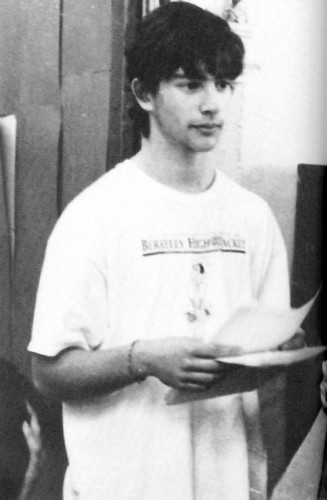
Moses (in a photo from his high school yearbook at right, not the Jacket T-shirt) joined the school newspaper staff in his freshman year and has been writing since (he was also a humor columnist for the Yale Daily News in his college years). But the writer says he’s still not sure if writing is “his thing.”

“When I was 9 or 10, I read a lot of sci-fi/fantasy. It was an obsession. I thought I’d write that. My initial plan was to be Piers Anthony or Susan Cooper or whoever. I got to Berkeley High, and I don’t know why, but I was attracted to the newspaper. I can’t remember how I made that decision. I liked it a lot. I knew it was my big high school extracurricular activity. Never planned to be a journalist.”

Then, in college, theater became his extracurricular activity, and now he’s a playwright in demand (his biggest hit, Bach at Leipzig, recently had its area premiere at Shakespeare Santa Cruz).

Working on Yellowjackets for the last two years, Moses was approached by a TV network – he says it shall remain nameless – about turning the play into a TV series. Unlike the play, which allows the young actors to play the adults as well as the students, the TV geniuses wanted to focus primarily on the adults.

“To me, the play is interesting because it focuses on the kids,” Moses says. “That’s what makes it a microcosm. For the purposes of TV, they may be right. But on stage, kids playing adults was the obvious choice.”

More than a decade away from his high school experience, Moses says maturity isn’t all it’s cracked up to be.

“If anything, I feel less clarity and less direct passion and less vibrating sense of the electricity of possibility of the world than I did when I was a teenager,” he says. “When I was in graduate school, Tony Kushner spoke to us, and the thing he said that I remember most vividly was that maturity in our culture is defined as the ability not to feel too strongly about anything. If you buy into that, especially as an artist, you’re screwed because it means you’re deadened. As writers, he said, be careful not to be embarrassed by the extremities of feeling. Certainly how much you want that in your life and relationships is a question, but you definitely want in your work. In Yellowjackets, taking the kids seriously, focusing on them was a way to do that…to write about characters whose id is louder than their superego.”

Moses will take part in a free “Page to Stage” talk on Berkeley Rep’s Thrust Stage at 7 p.m. Sept. 22.

Yellowjackets continues through Oct. 12 at the Thrust Stage, 2025 Addison St., Berkeley. Tickets are $33-$71. Call 510-647-2949 or visit www.berkeleyrep.org.

 

June 13, 2008

Berkeley Rep cancels `Yellow Face,’ tours Hoch

The 2008-09 season hasn’t even begun and already changes are afoot.

Berkeley Repertory Theatre announced yesterday that it will postpone David Henry Hwang’s Yellow Face, which was to have concluded the season.

Here’s from the press release: ” The theatre hopes to present the show in the fall of 2009 and then tour its production to other cities. (Tony) Taccone is now selecting a new script to conclude the 2008/09 season.”

The same press release — in much bigger and brighter language — also announced that Danny Hoch’s solo show Taking Over will tour. The Taccone-directed show, which had its world premiere in January, will head to Los Angeles (Mark Taper Forum, Jan. 23 – Feb. 22, 2009), Montreal (July 8, Just for Laughs Festival) and New York City (Public Theatre, fall 2008). This is the third work (after Sarah Jones’ Bridge & Tunnel and Tony Kushner and Maurice Sendak’s Brundibar) that Taccone has sent to New York in as many years and the fifth in Berkeley Rep history.

Said Taccone: “I’m proud of this piece and pleased that it will travel. By examining gentrification in his own neighborhood, Danny is grappling with issues that affect cities everywhere. Audiences at Berkeley Rep loved it because of his insight and humor, and I look forward to sharing it with a wider community.”

For information visit www.berkeleyrep.org.

April 10, 2008

Review: `Caroline or Change’


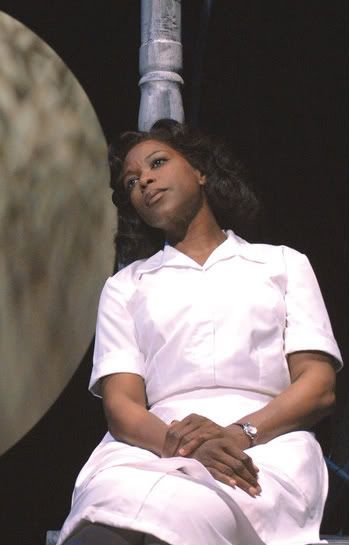
C. Kelly Wright is Caroline Thibodeaux in TheatreWorks’ Caroline, or Change (Anise Ritchie in the rear is The Moon). Photos by David Allen

TheatreWorks tackles challenging `Caroline’ with soaring results
Four stars (Rich, rewarding, moving)

I cannot imagine any other Bay Area theater company other than TheatreWorks having the guts to produce one of the most challenging – and, if done right, most rewarding – musicals ever written.

It is a testament to TheatreWorks founding artistic director Robert Kelley that he consistently programs the Bay Area’s most diverse theatrical season, complete with crusty old chestnuts and highly risky new work, plays and musicals. And his subscription base seems to go right along with him, relishing the opportunity to be pleased in ordinary ways and challenged in entirely new ways.

How else to explain the presence of Jeanine Tesori and Tony Kushner’s extraordinary musical Caroline, or Change, now running at the Mountain View Center for the Performing Arts? Without question, this is the most adventurous, most boundary-pushing musical to hit Broadway in a good, long time. Tesori calls it a folk opera, and she’s right. Her score sounds doesn’t sound like opera, but it has the weight of opera, though it incorporates the sounds of the late ‘50s and early ‘60s (the show is set in 1963) as well as the folk and blues sounds of Louisiana (where the show is set).

The Bay Area had a chance to see the phenomenal Broadway production of Caroline when lead producer Carole Shorenstein Hays brought it out to be part of the SHN/Best of Broadway season. It’s hard to imagine any version – let alone a regional theater production – measuring up to that superlative work.

But Kelley’s Caroline is every bit as good because it’s different enough to be its own thing. The primary difference is the intimacy of the Mountain View Center for the Performing Arts. The stage is big enough for a musical, but the house is small enough that you feel like you’re down in that sweltering basement (basements are unusual in Louisiana, where underground is underwater) with Caroline as she toils through the laundry of her employers, the Gellmans.

In the smaller space, you can really concentrate on the performances, which are entirely first rate, and on the score, which grows richer, more melodious and more emotionally complex with each hearing.

In the anchor role of Caroline Thibodeaux is Oakland’s C. Kelly Wright, a TheatreWorks veteran who has been away for a while but makes a welcome return to the stage in the meatiest role for a woman since Sondheim, Styne and Laurents created Mama Rose in Gypsy.

Not enough can be said about just how shattering Wright is as Caroline, the perpetually grumpy maid who says repeatedly: “I am mean, and I am tough, but $30 a week ain’t enough.” There are reasons Caroline is at odds with the world. Economics is a big part of it. She’s a divorced woman, 39 years old with four children (the eldest has been sent to Vietnam, “wherever that is,” Caroline says). She can barely read enough to find her way on a map, and she has deep, deep sorrow.

You feel every one of those sorrows in Wright’s blazing performance. Caroline’s already legendary Act 2 aria (again, it doesn’t sound like opera but there’s no better word for a song of such all-consuming emotion), “Lot’s Wife” is like a play unto itself. And Wright rises to the challenge of the piece and wallops the audience with the truest kind of hurt.

Much of Caroline is brainy and intellectual – not unlike an interesting New Yorker article – but when Kushner and Tesori decide to go for the heart, they do it in a big, beautiful way. And Wright is right there with them every step of the way.

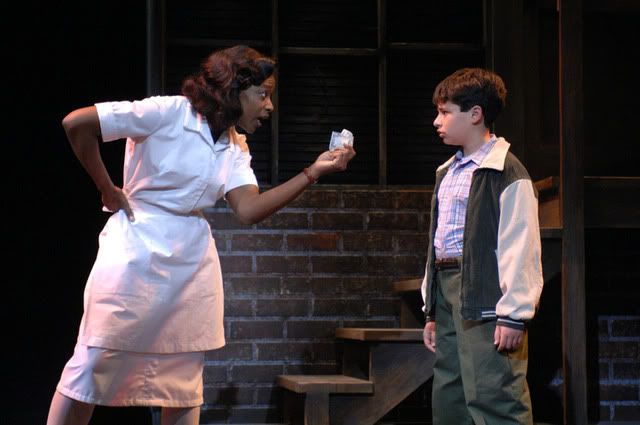
Also giving a superb performance is 12-year-old Julian Hornik of Palo Alto. He plays Noah Gellman, and he thinks Caroline, his family’s maid, is the best thing ever. He calls her the president of the United States, imagines that she runs everything and that she’s “stronger than my dad.” Of course just about anybody is stronger than Noah’s emotionally distant, clarinet-playing dad (Ryan Drummond), who quickly got remarried after Noah’s mom died of cancer.

Hornik’s pure, sweet voice is assured beyond his years, and he handles the challenges of the score with aplomb.

Eileen Tepper is Rose, Noah’s new stepmom, who desperately wants to be a good mother in spite of the fact that Noah seems to hate her. Tepper emerges as the show’s third star with an emotionally grounded performance that aches with the character’s desperation to be good and to do the right thing.

As Kushner’s book delves into change – from the coins Noah leaves in his pants pockets that Caroline is expected to keep to the massive change sweeping the nation in the wake of Kennedy’s assassination and the rise of the Civil Rights movement – the excellent cast continually surprises and delights.

James Monroe Iglehart shows some devilish sass as Caroline’s singing and dancing dryer, but then he gets to be a dignified mourner as a bus driver who announces the death of the president. Valisia LeKae is superb as Caroline’s daughter, Emmie, who is going through her own kind of growing-up changes – changes that indicate that she would never settle for being a servant to white people.

There’s a dreamlike quality to this musical (hence the singing-and-dancing dryer and washing machine) that is captured beautifully in J.B. Wilson’s elegantly swampy set design and Pamila Gray’s firefly-enhanced lighting.

There’s so much to love about this musical and this production of it that it’s difficult to not write a dissertation about how this unusual story about an African-American woman and a Jewish-American boy at a time of cultural upheaval could only be told as a musical – as this musical.

But I won’t do that. All I can say is this: See TheatreWorks’ Caroline, or Change and open your head and open your heart.

Caroline, or Change continues through April 27 at the Mountain View Center for the Performing Arts, 500 Castro St., Mountain View. Tickets are $25-$61. Call 650-903-6000 or visit www.theatreworks.org for information.

February 6, 2007

TheatreWorks’ new season

Jane Austen, Thronton Wilder, Tony Kushner and Golda Meir will all be there…sort of.

Robert Kelley, the founding artistic director of Mountain View’s TheatreWorks has just announced his company’s 38th season.

Unlike many theaters around the Bay Area, TheatreWorks begins its season in the summer, and this year, Bernard Pomerance’s The Elephant Man, the story of deformed circus sideshow attraction John Merrick, kicks things off June 20. TheatreWorks produced the play, which, unlike the movie version, leaves the deformities to the imagination, in 1985.

In July comes the West Coast premiere of Theophilus North, Matthew Burnett’s adaptation of the charming Thornton Wilder novel of the same name.

Next up in August is the world premiere of a new musical based on Jane Austen’s Emma, the tale of a well-meaninng matchmaker who finally stumbles into her own true love. Paul Gordon (Broadway’s Jane Eyre) contributes music, lyrics and book.

In October comes more serious fare: William Gibson’s one-woman show Golda’s Balcony, a peek into the complex mind and heart of Israeli Prime Minister Golda Meir.

For the holidays comes Shakespeare’s Twelfth Night, and with the new year comes a welcome old friend: the late Wendy Wassterstein (below), whose last play, Third, finally makes it to the West Coast.

In March 2008, Kathleen Clark’s Southern Comforts, a late-in-life love story, takes a bow, followed by the season-ending Caroline, or Change, with book and lyrics by Tony Kushner and music by Jeanine Tesori. If you saw the touring Broadway version in San Francisco, you know this is one of the most powerful and important musicals to come along in the last decade or so. If you haven’t seen it yet, here’s your chance.

Subscriptions for the season range from $100 to $373 and are available now. Single tickets go on sale June 1. Call (888) 273-3752 or visit www.theatreworks.org for information.

September 6, 2006

Quoting Taccone

Berkeley Repertory Theatre artistic director Tony Taccone, now in his 10th season with the theater, is the subject of an excellent new article in Theatre Communications Group’s American Theatre magazine. The author is actor/writer Ellen McLaughlin, the original angel in Angels in America, which Taccone originally co-directed with Oskar Eustis at San Francisco’s Eureka Theatre.

This has been quite a year for the 55-year-old Taccone. He took
Maurice Sendak Tony Tacconeand Tony Kushner’s Brundibar to New York.
He took Sarah Jones’ extraordinary Tony Award-winning show Bridge & Tunnel to Broadway, and he continues in his collaboration with Culture Clash after last season’s world premiere of Zorro in Hell.

The whole article is worth reading (check it out here). Or at the very least, check out a couple of Taccone’s quotes below:

?Every theatre in America talks about risk. It?s on every brochure. Everybody wants to say they take risks, and nobody wants to live with what happens if you actually take them. I say to our audience, ?I don?t love everything we do, but I respect everything we do. This theatre is big enough, confident enough and responsible enough to deal with ideas and feelings that challenge us all.? ?

?Lately, working with Sarah Jones and Culture Clash, I find myself moving more toward life-affirming performances because I think the world needs it. I think I need it. It?s just too hard sometimes to weather what?s going on in the world without some primordial experience of release, some need to reconnect with each other.?

Powered by WordPress