Chad Jones’ Theater Dogs

April 13, 2008

In the process: Open rehearsal

Filed under: Campo Santo, Intersection for the Arts, Philip Kan Gotanda — Chad Jones @ 12:01 am

A quick note to alert Bay Area folks about an interesting opportunity coming right up.

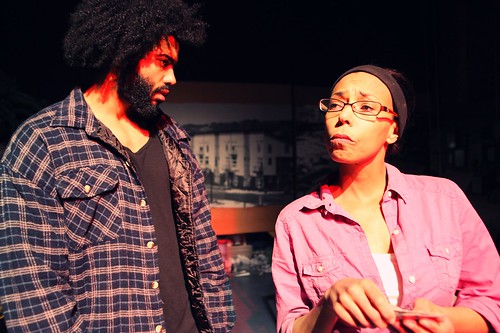
On Friday, April 18 and Saturday April 19, Campo Santo is opening up its rehearsal process to give audiences a peek into Bay Area playwright Philip Kan Gotanda’s new play, #5 The Angry Red Drum at Intersection for the Arts.

This is part of Campo Santo/Intersection’s Open Rehearsal and Open Process Series exploration. Presented in collaboration with the Asian American Theater Company, Gotanda’s play is set in an apocalyptic world and addresses the effects of war on our psyches and culture.

This is a rare chance to see some fantastic Campo Santo folks in the throes of their creativep rocess: movement direction by Erika Chong Shuch, live music score from Dwayne Calizo and featuring Samantha Chanse, Daveed Diggs, Randy Nakano, Donald Lacy and Danny Wolohan.

Make reservations at www.theintersection.org or call 415-626-3311 for information.

March 13, 2008

Theater Review: `June in a Box’

Opened March 10, 2008 at Intersection for the Arts, San Francisco

New musical finds lyricism in true crime
three stars Enigmatic Box

About four years ago, playwright Octavio Solis and composer Beth Custer collaborated on a surprising (and surprisingly delightful) musical called The Ballad of Pancho and Lucy, based on a true-crime story of bandits who robbed bars in San Francisco’s Mission District.

Solis and Custer have returned to their true crime musicalizing ways with June in a Box, a perplexing one-act musical now at Intersection for the Arts.

The show is based on the story of June Robles, an elementary schoolgirl who, in 1934, was kidnapped by two men, buried in a box in the desert outside of Tucson, Arizona and left there for 19 days. The story was also turned into a “corrido,” or Mexican-American ballad called “Ell Corrido de la Nina June Robles” (thoughtfully included in the program in its entirety in English and Spanish).

From the outset, I have to admit I was bothered by the idea of the show: cruelty inflicted on children as entertainment. Not my idea of a good time.

But Solis is a sensitive artist, and the show, though it lacks an overarching theme or impact beyond its biographical details, is an interesting musing on how June’s experience in the desert affected her in later life.

Solis directs the 85-minute show himself and has cast his disarming daughter, Gracie Solis, as young June, whom we see in flashbacks enduring her desert horror with astonishing fortitude. Custer is at the piano and clarinet, assisted by an accordion player (an alternate filling in for Isabel Douglass the night I saw the show).

The tale is told through the prism of June’s old age, and as an older woman she’s played by the extraordinary Denise Blasor, who sings and acts with ferocity and realism.

Luis Saguar and Marc David Pinate play various roles, from hungry coyotes prowling the desert and tormenting the older June, to the men in young June’s life: her father, her grandfather, her district attorney uncle and her kidnappers.

James Faerron’s set is an artful junk heap — timber and corrugated metal sheets — dominated by a box center stage. This is June’s prison, though the fantastical flow of the play means June isn’t always confined (and when she is, the sides of the box are see-through).

Why this story needed to be a musical — especially when it had already been turned into a ballad — is mysterious. Perhaps because the older June is coming to the end of her life and needs to re-live the defining moment of her life — 19 days buried alive — and its lifelong aftermath, she needs music to give it all the lyricism of a dream. “The fever of 19 days is gone, but it leaves a constant chill,” June says in her reverie.

Some of Custer’s music is wonderful, full of emotion and melody. Other moments aren’t so successful. For instance, Pinate and Saguar break into a number asking “Where is June?” and both the tune, their singing and Erika Chong Shuch’s choreography come together in awkward ways that constitute a musical stumble.

Young Gracie Solis is a genuine talent — beautiful, believable and a fine singer. She gives weight and light to the story, which wants very much to become as lyrically intense as the musical Floyd Collins, Adam Guettel’s musical tale of a man trapped in a cave, but it never quite attains that level.

June in a Box continues through March 31 at Intersection for the Arts, 446 Valencia St., San Francisco. Shows are at 8 p.m. Thursdays-Sundays (plus 8 p.m. March 31); no show March 23. Tickets are $10 to $25 on a sliding scale. Call 415-626-3311 or visit www.theintersection.org for information.

February 6, 2008

Margo Hall gets the `Blues’

You’re forgiven if you didn’t know quite how amazing Margo Hall is.

If you’re a regular Bay Area theatergoer, you already know that Hall is an extraordinary actor. Last year, for instance, she reprised the character Fe in Campo Santo/Intersection for the Arts’ Fe in the Desert and gave one of the year’s best performances.

But Hall is also an accomplished director. She was one of the creative collaborators and one of the performers in Berkeley Repertory Theatre’s award-winning docudrama The People’s Temple, and last year she co-directed Shotgun Players’ excellent Bulrusher at the Ashby Stage.

Surprisingly, Hall says she prefers directing to acting.

“I say that when I’m directing,” Hall says. “I do love acting, but there’s something so fun, so freeing about directing.”

And one of Hall’s favorite directing gigs is for Word for Word, the San Francisco company that does amazing work turning short works of fiction into fully staged theater pieces without changing a word of the original text.

With Word for Word, Hall has been both performer (Langston Hughes’ The Blues I’m Playing, Barbara Kingsolver’s Rose-Johnny, Zora Neale Hurston’s The Gilded Six Bits) and director (Alice Munro’s Friend of My Youth, Greg Sarris’ Joy Ride).

She finds herself back in the Word for Word director’s chair for James Baldwin’s Sonny’s Blues, which opens tonight at San Francisco’s Lorraine Hansberry Theatre.

Baldwin’s story, published in 1957 and collected in the 1965 book, Going to Meet the Man, follows two brothers in 1950s Harlem. One is a schoolteacher and family man. The other is a jazz pianist with a troubled past.

Hall, who grew up in Detroit and now lives in Oakland with her husband, the actor L. Peter Callender, and their 12-year-old son, reread the story and responded to it immediately.

“Visualizing the piece wasn’t difficult,” Hall says on the phone from her home. “Ever since I’ve worked with Word for Word I can’t read a story without visualizing it. I didn’t visualize the story’s opening moment right away — that took some time. But I clearly saw other parts.”
The story’s jazz milieu was a natural for Hall, whose stepfather was a jazz musician.

“I was exposed to Sonny Rollins and a whole lot of other jazz cats,” Hall says. “I was familiar with the world of be-bop. My dad’s 15-piece band rehearsed in our basement. When I was rereading the story, this music, these people — Charlie Parker, Bird – I just knew it. It was familiar. I could hear the music and everything. It was really exciting.”

With jazz music so prominent in the story, Hall had to decide how to handle music in the production. Should there be live music? Should the actors play instruments themselves? At first, Hall considered casting her friend, the actor and beat-boxer Tommy Shepherd, but then she decided to go for the full jazz sound.

She approached her friend and previous collaborator Marcus Shelby, a prominent Bay Area jazz musician.

“I knew Marcus would know this story, this world,” Hall says. “The more we talked about the show and the score, the more I talked about the sounds in the show — the traffic, the subway — all being created by instruments in a very stylized way.”

Ideally, Shelby and his band would be playing live for each performance, but Hall says that would have required more time in an already crowded rehearsal schedule, so the score is recorded. But on Feb. 15, after the performance, Shelby will perform the music live at a gala reception.

One of the most extraordinary (and most consistent) things about Word for Word is the company’s skill at making literature come to life in surprising ways that enhance the story. The experience of seeing a Word for Word show is often as rich as reading and as thrilling as live theater because the show is, quite literally, both.

For Hall, the key to a good adaptation is transformation.

“It’s easy to put the story up, make it narrative and let the audience enjoy the beautiful language,” she says. “But capture the essence of the story is hard. We as the creative team have to go so deep that the audience can see the transformation and get a true, honest sense of what the story is when they leave.”

The more narration in a story, the harder it is to stage. Not surprisingly, if a story has a lot of dialogue, it’s fairly easy. Sonny’s Blues lands more on the narration-heavy end of that scale.

When Hall directed Friend of My Youth, another narrative-heavy story, she elected to direct her actors away from talking directly to the audience.

“This time, I went, `No, I’m gonna do it.’ The actors should definitely address the audience,” Hall explains. “This story is so universal — it’s about relationships and siblings. One is this conservative guy who went to school and became a teacher. Most of the audience will relate to him. Let’s have him talk to the audience, then get back into the scenes. This gives me as a director the opportunity to make bold choices.”

Next up for Hall: directing a solo show by Ariel Lucky, Free Land, about his family’s pioneer history and interactions with American Indians. She’s also continuing to teach at Chabot College (“I love my kids…they lift me up with their zaniness”) and being a mom.

“My son is a computer genius,” she says. “He has his own computer business and Web site. He fixes computers. He loves reading Shakespeare, but he wants to be a CEO.”

Sonny’s Blues continues through March 2 at the Lorraine Hansberry Theatre, 620 Sutter St., San Francisco. Shows are at 8 p.m. Wednesdays-Saturdays; 2 p.m. Sundays. Tickets are $22-$36. Call 415-474-8800 or visit www.lhtsf.org or www.zspace.org.

October 23, 2007

Whooping it up in `Des Moines’

Campo Santo, Denis Johnson go a little crazy in Iowa
Three and 1/2 stars Comic, dramatic depth charge

There’s a lot of wonderful weirdness in Denis Johnson’s Des Moines.

The play had its brief, three-performance world premiere last weekend, not at Intersection for the Arts, the usual home for Campo Santo works. This season is all about breaking patterns and trying new things (the slogan is: “New Definitions of Theatre, Don’t Let the Evolution Happen Without You”).

So Des Moines unfolded in the warehouse-y confines of artist John Gruenwald’s Gruenwald Press, a South of Market spot that required audience members to ride a freight elevator one floor up to the show.

Before the show began, the audience mingled in the space – crowded with a variety of sofas, stools, chair and pillows on the floor – partaking of the hors d’oeuvres buffet and the open bar while the Howard Wiley Duo played some smoky jazz in the corner by the windows.

Once settled into the hodgepodge of seats, the audience trained its attention on Leslie Linnebur and Joshua McDermott’s set: an average kitchen in Des Moines, Iowa. The one thing this kitchen had that kitchens in Iowa most likely do not: audience members seated in it.

And at Sunday’s performance – closing night – author Johnson was seated in the kitchen, so we had the pleasure of watching the play and watching the playwright watch the play (he liked it, he really liked it).

With each new play, starting with 1999’s Hellhound on My Trail through 2004’s Psychos Never Dream, Johnson seems to rattle the theatrical cage even more.

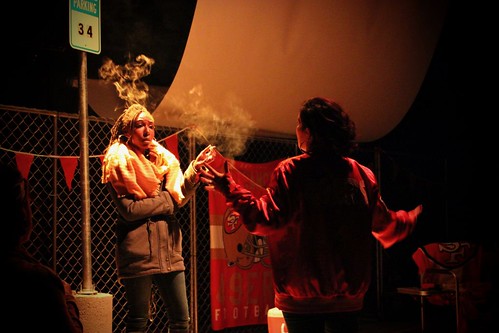
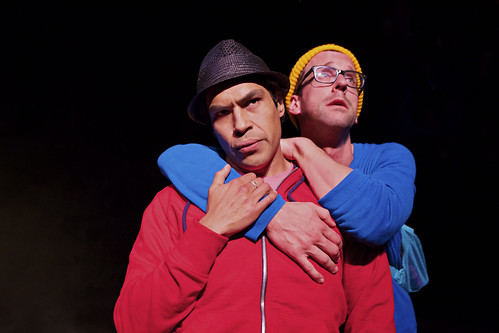
Des Moines is a curious work. It begins in complete naturalism as husband and wife Dan (Luis Saguar, above right) and Marta (Jeri Lynn Cohen) deal with everyday things, like Dan’s loathing of margarine. He lectures Marta that “oleo” means “made of oil.” She’s heard it all before, which is why she buys butter. “You like it. I got it. Now eat it. I love you,” she says.

From the first, this 85-minute “exploration of the damaged American soul,” as the program puts it, obsesses over mortality. Dan had a passenger in his cab, a woman recently widowed when her husband died in a plane crash, and she was obsessed with finding out her husband’s last words and thought maybe the cabbie could provide them.

Turns out the husband was a step ahead of her and had put a note in his pocket that read: “If I die now, my last words were: Orange juice, please.” Then, for some strange reason, the widow left her husband’s wedding ring in the cab.

Back in the kitchen, Marta announces she has some news and one of the local priests, Father Michael (Cully Fredricksen), is coming over. When Marta tells Dan that she has between two and four months to live, she turns to the priest for guidance and comfort.

“There’s very little to say,” he says.

“But to have a priest say it is something,” Marta says.

Desperation, mortality and the need for meaning and release flood into the kitchen, and that’s just the start. The priest is a cross-dresser, and Dan and Marta’s grandson, Jimmy (Max Gordon Moore), was paralyzed during the waist down during his sex-change operation.

While Dan and Marta are out buying beer and whiskey to make depth charges (shot glass full of whiskey dropped into a glass of beer, aka a boilermaker), the widow, Mrs. Drinkwater (Margo Hall, above left) shows up to reclaim her husband’s wedding ring.

What she finds is Jimmy in his wheelchair wearing a tight ‘70s dress, full makeup, Jackie O sunglasses and long brunette wig, and Father Michael wearing rouge, eye shadow and lipstick.

The priest, the transsexual and the widow get a head start on the depth charges, so when Dan and Marta return, the party is in full swing. Next thing you know, the karaoke machine is on (terrific sound design by Gustavo Pastre and Drew Yerys), and Jimmy is singing “Folsom Prison Blues,” the priest recites a dramatic monologue to “Love Me Tender” and the widow gets down and dirty to “Kansas City.”

Then the weirdness starts, and I’m not talking about Marta screaming, “The widow is a whore! The black widow is a whore!”

Director Jonathan Moscone doesn’t usually traffic in onstage weirdness, and that’s a strength here. When Johnson’s text veers out of naturalism and into dream chaos, Moscone’s firm hand — and the good will he has established with the audience through strong direction and excellent performances – keeps the play from spinning into self-indulgent whimsy and tragedy.

Events in the last scenes of the play may be inscrutable, but we’ve come to like this odd assortment of people so conveniently thrown together for a collective dark night of the soul.

Des Moines hasn’t quite found its ending yet, but the play leaves its audience with an electrical charge that crackles with humor, mortality and the need for community – in a depth charge, Iowa sort of way.

For more on Intersection for the Arts and Campo Santo’s fall 2007 events visit www.theintersection.org.

October 17, 2007

Campo Santo, Johnson together again

Campo Santo, the small theater company with major literary impact, is not doing a traditional season.

Sean San Jose, Campo Santo founder, and Deborah Cullinan, executive director of Intersection for the Arts, describe this offbeat season as a “search for the most exciting and bold new theatrical constructs.”

The season includes three world-premiere plays by some literary heavyweights, but each premiere lasts a limited time.

First up is Denis Johnson’s Des Moines, which opens Oct. 19 and closes Oct. 21. That’s right, three performances only. And guess what? The shows were sold out before rehearsals even began.

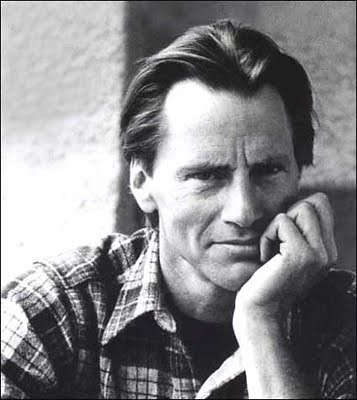
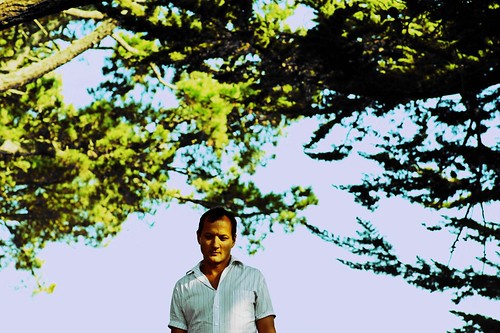
That’s what Johnson’s name can do, and that’s only speaking of him as the playwright of such extraordinary work as The Soul of a Whore, a previous Campo Santo-Intersection collaboration. Never mind that last week Johnson (above) was nominated for a National Book Award for his epic Vietnam novel, Tree of Smoke. People around here love Johnson as a playwright (OK, as a novelist, short-story writer and all-around great guy, too).

The tag-line for Des Moines is: “Come to a party…where a play breaks out!” And that’s pretty much what happens. Ticket buyers are given a super-secret location in San Francisco. They show up and take part in a cocktail party — complete with live music and cocktails — and the play sort of unfolds around them. Attendees can expect to meet a cabbie, a devout grandmother, a grieving widow and a cross-dressing priest among others as they randomly collide at a cocktail party in the Mission District and a small house in Des Moines, Iowa.

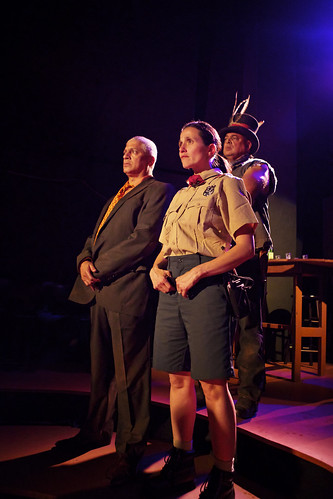
Jonathan Moscone, artistic director of California Shakespeare Theater, directs a cast that includes Jeri Lynn Cohen, Cully Fredericksen (below), Margo Hall, Max Gordon Moore and Luis Saguar.

If you’re intent on getting into Des Moines (and who could blame you?), you can put your name on the waiting list by e-mailing reservations@theintersection.org.

But wait, there’s more!

And because one new Johnson play is never as good as two new Johnson plays, Campo Santo and Intersection are premiering another one: Everything Has Been Arranged, a collaboration with Southern Exposure (an artist-run contemporary-arts and arts-education group) based on Johnson’s story “The Small Boys’ Unit,” about civil wars in Liberia, from his book Seek.

San Jose directs the show, which is part of Grounded?, a series of juried projects at Intersection that includes new visual art, public intervention, performance and media in search of physical, personal, social, political and creative ground.

Everything Has Been Arranged is only being performed three times: Dec. 6, 7 and 8 at Intersection. The evenings will also include performances of unpublished interviews on the Sudan civil wars culled from the newest publishing imprint from McSweeney’s, Voice of Witness.

Also part of Grounded? is Vendela Vida’s new theater piece, let the northern lights erase your name, directed by Danny Scheie. The piece is from Vida’s novel of the same name, which one reviewer described as walking “a very fine line between high-camp comedy and lyrical seriousness.”

let the northern lights erase your name will be performed Dec. 13, 14 and 15 at Intersection.

For a complete listing of Grounded? events, call 415-626-3311 or visit www.theintersection.org.

June 5, 2007

Review: `Fe in the Desert’

Opened June 4, 2007, Intersection for the Arts

Hagedorn finds dramatic heat in `Desert’ comedy
three stars Fun, unfocused

Fe looks into the desert surrounding her multi-million-dollar home and sees nothing but a “vast, wide-open burning piece of nothing.”

Clearly she’s not happy. Her nine-year marriage to a very nice, very rich man leaves her bored. The desert isolation is, well, too isolating, and she gets through each day with help from her addictions — to shopping and to cocaine.

That’s the status of Fe’s existence when we meet her in Fe in the Desert, a world-premiere play from former San Francisco writer Jessica Hagedorn, again collaborating with Campo Santo and Intersection for the Arts.

Fe in the Desert is actually a prequel to Hagedorn’s 2005 play Stairway to Heaven, which takes place in San Francisco’s Tenderloin District. In that drama, Fe appears after the collapse of her marriage.

In Fe in the Desert, we find Fe on the verge of making a big change in her life. It’s her birthday, and she was almost run off the desert highway by a woman driving a truck full of meat.

As if that weren’t sign enough (and Fe is sure it’s a sign), Fe’s birthday celebration is interrupted by two newly sprung ex-cons, guns in hand, looking to — to what? Are they going to rob the place? Kill Fe and her sniveling husband? Or is there something else going on?

Unlike the earlier Stairway to Paradise, Fe in the Desert is a sprawling narrative that attempts to juggle the stories of three couples simultaneously.

We have Fe (played, as in the earlier production, by the glorious Margo Hall) and her sweet, simpering husband (Danny Wolohan); then there are the criminals, Tyrone (Robert Hampton) and Mook (Jonsen Vitug), whose relationship has a tough romantic edge to it; and there’s movie producer Ramon (Michael Torres) and his new Lebanese secretary, Suze (Sara Hernandez), whose function in the play is never really clear.


Hagedorn and director Danny Scheie sure know how to keep things lively and entertaining, even if they can’t quite get us to that definitive moment when all the elements come together.

The previous play was like this as well: fun to watch, engaging and full of great performances but, in the end, somewhat inscrutable.

There’s a lot of comedy in this Desert, but the sassy tone, whether conveyed in extensive use of pop music (Beyonce and Jay-Z’s “Crazy in Love,” the Chi-Lites’ “Have You Seen Her”) or in Hall’s take-no-crap attitude, obscures some of the play’s shadows.

In terms of design, the production is striking. Lisa Dent’s set makes frequent use of the automatic garage door and the billowy white curtains that fill the small Intersection performance space. And Timothy Jordan’s droll designs fill video monitors on either side of the stage.

The house invasion never quite seems credible, though Wolohan’s terrified homeowner gives weight to the situation. Scheie’s zippy direction keeps leaning toward comedy, but the play seems to want moments of more realistic trauma.

Still, it’s hard to complain when we’re so grandly entertained by the dance-off between Fe and Mook. If you’re ever faced with a life-threatening home invasion, you might consider a dance-off to ease the tension.

The two-hour play finally brings together all three couples but without a satisfying result. The Ramon-Suze pairing seems tacked on, and Fe’s impulse to up and leave when the turbulent night is finally over seems more convenient than earned.

But we understand. Fe has another play to get to.

For information about Fe in the Desert visit www.theintersection.org.

March 6, 2007

Review: ‘A Place to Stand’

opened March 3, 2007 at Intersection for the Arts

Poetry, prison fuse as Campo Santo finds `A Place to Stand’
three [1/2] stars Poetic, powerful

Hers is a cry that rings in your ears long after the actual sound ceases.

The soul-deep pain of a mother whose child is taken from her reverberates through every decibel of her scream.

There is much to provoke the eye and the ear in A Place to Stand, a world-premiere performance piece created by Campo Santo and Intersection for the Arts from the writings of Jimmy Santiago Baca and Ntozake Shange.

In an impressionistic evening of songs, poetry and emotion about prison and its ripple effects, nothing registers more strongly than Catherine Castellanos’ extraordinary performance as Julia, a Mexican immigrant whose hardscrabble existence is weighted with grief for her imprisoned son, Terrazo (Carols Aguirre).

We see Julia fretting over her boy and his seemingly constant run-ins with the law. Then, in a canny flashback, we see a flustered, angry Julia visiting her husband in jail and bringing her 5-year-old son with her.

The husband doesn’t want his son to see him in such a demeaning state.

“If you don’t want him to see you like this,” Julia barks, “don’t BE like this.”

Though there’s no straight narrative line through A Place to Stand, which opened Sunday at San Francisco’s Intersection, though there are enough fragments of stories to create the illusion of plot.

When we meet Julia, she’s awaiting news of her son’s possible parole, but he is denied once again, and her anger, frustration and sadness pour out in an impassioned monologue that includes her searing scream — the agonizing sound of a mother finally giving up.

That’s one of the most powerful moments in director Sean San Jose’s provocative 70-minute show, which is the first piece of Intersection’s year-long Prison Project — various artistic endeavors aiming to illuminate and address the California Prison System.

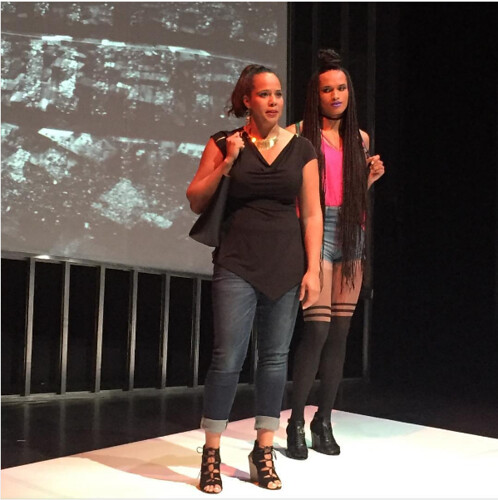
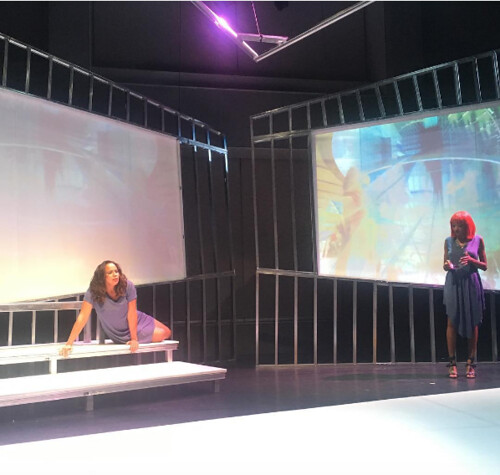
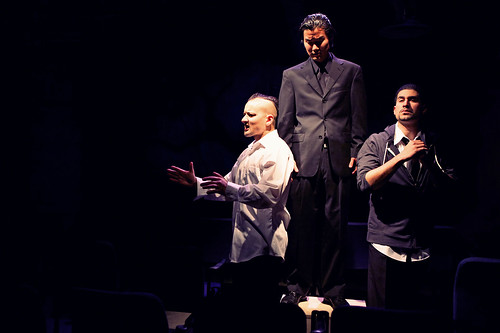
In A Place to Stand, which blends Oakland resident Shange’s Liliane with Baca’s autobiography A Place to Stand and his story “Sons of Julia,” we meet a survivor of the prison system, Cyclone (Marc David Pinate, pictured below), who serves as sort of a narrator.

He introduces us to the men in prison (Aguirre and Florentino Gonzales as Coro) and to the women: Savannah Shange (Ntozake’s daughter) as Liliane and Scheherazade Stone as Lily (both women pictured above).

Liliane’s story involves a drug deal gone bad. When the police arrive to make a bust, her boyfriend makes her ingest the cocaine to get rid of it, even though she’s pregnant.

She loses the baby and ends up in jail, but the spirit of her little girl, called Esmereldita (Sara Hernandez), then haunts her imprisoned parents.

All of this could be so much artistic folderol, more relevant to the artists than to the audience, but director San Jose has total command over the tone and the emotional authenticity of the piece.

Music plays an important role in the production. There’s recorded music from Howard Wiley and the Angola Project — covering everything from hymns to riot-fueled jazz — along with a live score created by Wiley and Tommy Shepherd.

Aguirre’s onstage beatboxing adds a compelling percussive layer to the show, and Stone’s remarkable singing — she sings mostly Bob Marley songs — could be a show all by itself. There’s vitality and ache in every beautiful note.

Visual designer Victor Cartagena, working in tandem with lighting designer Ray Oppenheimer, goes for carefully crafted simplicity. There’s a sliding door at the back of the stage that clangs and pounds like a prison door, and when it’s open, life-size video projections blend past and present, freedom and confinement.

Above the action, also on the back wall, is a photograph behind bars, a sweet black-and-white photo of a young Terrazo — or maybe it’s Cyclone or Coro. Whoever’s image is up there, it’s innocence incarnate.

Not all the show’s pieces fall together. Hernandez’s Esmereldita remains a perplexing presence, and Gonzales’ Coro is underutilized.

But the final impression of A Place to Stand remains powerful. The show provokes thought while it stirs emotion. And that mother’s cry echoes without end.